

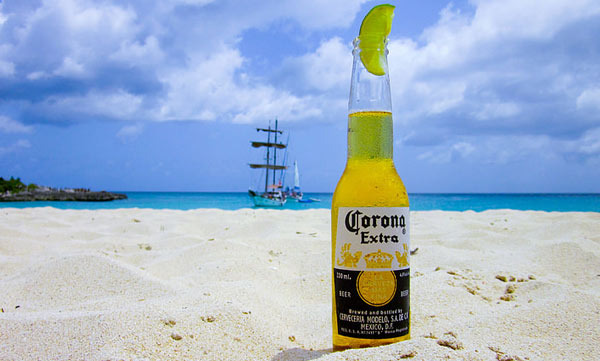
Last weekend, I gathered with friends at a bar in downtown LA for the first time in a while.
We ordered a bottle of Corona each and naturally started adding lime to our drinks.
At that moment, one friend jokingly said, "Isn't it true that you can put any beer in a Corona bottle and it will taste like Corona?"
Everyone started searching on their phones. It turns out that Americans have already conducted this experiment.
When you think about it, Corona beer occupies a unique position.
With its clear bottle, beach imagery, and lime, it's a beer that is consumed more for the atmosphere and experience than for its taste.
To put it like a 90s ad, this is not just a beverage; it's a lifestyle.
On Reddit and various beer communities, blind tests comparing Corona vs Budweiser vs Coors have been conducted multiple times.
The method is simple: pour the brands into cups to hide their identities, add lime, and see if you can guess which is which.
The results are surprisingly consistent. Most participants couldn't even guess half correctly.
In some cases, it was almost random.
The reason for this can be explained scientifically. The acidity and citrus aroma of the lime largely mask the hop aroma and malt flavor of the beer.
Especially for light lagers like Corona, Budweiser, and Coors, the basic structure is quite similar.
When you drink them ice-cold, it becomes nearly impossible to notice the subtle differences.
One American user made an impressive statement: "The moment you add lime, it becomes a lime drink, not beer."
It's as if the brand creates the flavor.
The more interesting part is the psychological effect, haha.
When you drink from the bottle, you think, "Corona is refreshing," but when it's poured into a cup, you can't quite identify that characteristic.
In other words, what we're drinking is likely not the actual taste but the brand image.
Living in LA, I often see this phenomenon.
When you're enjoying a barbecue at home on the weekend, holding a Corona while looking at the beach with friends, you've already achieved half of a successful lifestyle.
It's a culture of drinking the atmosphere rather than the beer itself. In this multicultural city, consumption that the middle class and above can enjoy is always experience-centered.
This isn't so much a criticism as it is a characteristic of modern consumption. We buy stories, not functions.
One interesting conclusion: when you add lime, most mainstream lagers become similar.
This means the differences between brands diminish. In a sense, it's the most democratic drinking state.
However, if you remove the lime and drink slowly at a temperature close to room temperature, the story changes.
Experienced drinkers can distinguish differences in carbonation strength, mouthfeel, and aftertaste when the aroma tingles at the tip of the nose.
Ultimately, the issue isn't the beer; it's how we drink it.
Sometimes I think of this. There was a line in Friends: "It's not the coffee. It's the place."
The same goes for Corona. What matters is not the lime, but the people and the atmosphere around you.
So next time you gather with friends, give it a try.
Put a different beer in a Corona bottle, add lime, and do a blind test.
You probably won't guess as well as you expect. And in that moment, you'll realize that what we drank wasn't beer, but memories and images.
The reason the lime scent rises in the evening air of LA might be that it's not about the taste, but the feeling.







 US Embassy |
 fortbliss |
 Folding Instructions |
 yentra |
 Cali M Law Group |
 Weekend Movie Blog |
 Beauty, Health, Lifestyle Blog |
 coloradoman |
 Superman Cat Blog |
 novapixel |
  Korean Mom |
  My NYC |
  moo moo |
  Mr Oh |
  forevergee |
  festival |
  manchester |
  constant |
  Leapfrog Move |
  vibranto |
  Tora Tora |
  yellowbutter |
  Dolly |
  NYC saladbar |
  Finding Superfoods |
  lightyear |
  song bang |
  vexomo |
  Indiana Jones |