

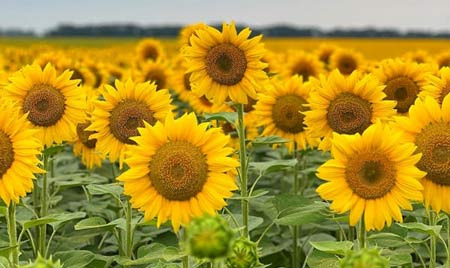
Sunflowers are aptly called 'flowers resembling the sun.' But did you know that this flower is not just beautiful? The sunflower oil we often use in cooking is a precious gift derived from this flower.
In the U.S., sunflowers are quite an important crop, with North Dakota, South Dakota, and Minnesota accounting for about 70% of the total production. These three states are so significant that they are referred to as the 'Sunflower Belt.' Of course, the area has slightly decreased due to competing crops like corn and soybeans, but they still paint the central northern plains of the U.S. yellow.
Heading south, Kansas and Texas cannot be overlooked. This region has a warm climate, allowing for early planting in spring and harvesting before midsummer. As a result, many tourists are disappointed when they visit during summer vacations and find that "the flowers have all wilted." Sunflowers are actually members of the daisy family, related to chrysanthemums and asters. Originally from Central America, they spread worldwide when Columbus brought them to Europe in the 16th century. Europeans, upon seeing their vibrant appearance, called them "sunflowers."
But why is it called a 'flower that follows the sun'? The reason is simple. Young sunflowers really do turn their heads to follow the sun. During their growth period from spring to summer (March to August), the stem moves from east to west, following the sun's trajectory. This phenomenon is due to a plant hormone called 'auxin.' Auxin moves away from light towards the darker side, causing that side of the stem to grow longer, resulting in the sunflower buds bending towards the sunlight. This way, sunflowers maximize their sunlight absorption throughout the day.
Sunflowers particularly thrive in dry, sunny grassland areas. Ideal conditions are warm days around 25 degrees Celsius and cool nights. They grow well in well-drained sandy or loamy soils, and their deep roots help prevent soil erosion. In northern regions, they are sown around May and harvested in the fall, while in the south, they are planted in March or April and harvested by mid-summer. Just looking at the calendar gives you a sense of where the 'Sunflower Belt' is located.
Surprisingly, sunflowers can grow quite large. In good soil, they typically reach heights of 4 to 8 meters, with the world record being an astonishing 12 meters. The flower head can exceed 80 cm in diameter, almost the size of a human torso. However, nowadays, farmers often cultivate dwarf varieties around 1 meter tall to increase harvest efficiency. Conversely, ornamental varieties are grown shorter, making them perfect for decorating gardens or roadways.
Currently, the price of sunflower oil is somewhat stable overall, but premium lines like 'High Oleic' or 'organic' are steadily growing. Farmers are seeking new breakthroughs with products that emphasize health functionality and quality, moving away from standard varieties. Sunflower oil is popular as a healthy cooking oil due to its low trans fat content and high vitamin E levels.
Thus, sunflowers are not just flowers that color the summer landscape; they are 'versatile plants' that impact the cooking oil industry, agricultural ecosystem, and environmental conservation. Just like their appearance of lifting their heads to the sunlight, sunflowers are crops that always convey bright and positive energy like the sun.




 El Dorado |
 lightyear |
 Moscow Kim |
 coloradoman |
 Montgomery Mom |
 Northeastern |
 Nationally Certified Lightning Charcoal Review |
 sparkling |
 American Grape Shine Muscat |
 U.S. Weather Bureau News |
  DREAM BIG |
  frostbite |
  330 Forever My Love |
  dralix58 |
  Gorama Round |
  Skydiving |
  dreamport |
  Yellow Snowman |
  Toaster Pizza Magic Show |
  velvetnom |
  Anytime Journey |
  Mrs. Duluth |
  jaxter |
  Atlanta Mama |
  Baguette Blog |
  Tan Sol |
  US Embassy |
  Korean Mom |
  My NYC |