

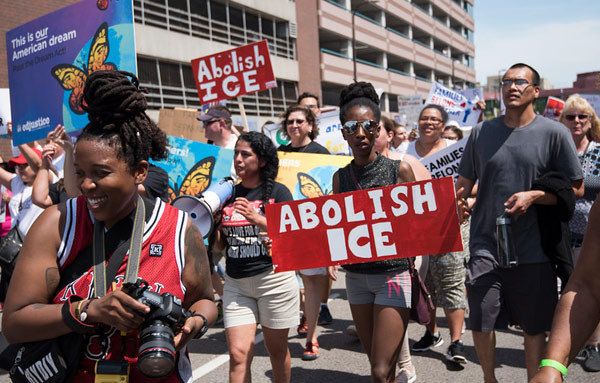
These days, when you watch the news in the U.S., you can't help but notice that stories about ICE, which many people previously didn't know much about, are always coming up.
Recently in Minnesota, two American citizens were shot and killed by ICE agents in consecutive incidents.
The first incident occurred on January 7, when 37-year-old Renée Good was shot by an ICE agent in Minneapolis. Reports indicated that Good, who was inside her vehicle, was shot in what was described as self-defense after the agent approached her, but witnesses claimed there was no threat, leading to a growing controversy. The local community and human rights organizations condemned the excessive response, which led to widespread protests.
About 17 days later, on January 24, another incident occurred. A 37-year-old American citizen named Alex Pretti was shot and killed by ICE and Customs and Border Protection (CBP) agents in downtown Minneapolis. According to footage from the scene and statements from his family, Pretti was subdued by the agents while trying to help others and was subsequently shot multiple times. In contrast, federal authorities claimed that Pretti was armed and resisted arrest.
The fact that Pretti was shot while not in a situation where he was drawing a weapon shocked the community, and both the Minnesota governor and mayor are calling for an end to violent enforcement and the withdrawal of agents. Many citizens are holding peaceful protests, demanding accountability and a broader investigation, intensifying the debate over immigration enforcement and the use of public power in the U.S.
Now, scenes of ICE enforcement and protests against it are constantly appearing. Just a few years ago, it felt like these issues were only happening in certain cities like New York or LA, but now it seems like the entire country is involved.
Watching this, I often find myself confused about whether the U.S. is becoming more divided between left and right, or if the left is simply rebelling on its own.
I can understand the starting point of the ICE protests. There are ongoing reports of forced arrests during illegal immigration enforcement, family separations, and excessive responses on the scene.
Especially in states with large immigrant populations like California, New York, and Illinois, there is a clear perception of ICE as a violent presence of the federal government. The problem is that this criticism is increasingly moving beyond policy discussions to become an emotional battle.
There is a compelling argument that this situation reflects a division in national opinion. Immigration issues are already a core conflict in the U.S. intertwined with economics, security, race, and culture. The boundaries between legal and illegal immigration are ambiguous, and federal and state governments often voice differing opinions, leading to ongoing clashes between law enforcement and human rights protections.
On the other hand, many people view these protests as a backlash from the leftist politics left by the Democratic Party. Over the past decade, the Democratic Party has elevated immigration issues to a moral agenda. The message that undocumented immigrants are vulnerable individuals deserving protection has been repeated, and the atmosphere of viewing enforcement itself as evil has grown.
As a result, the legitimacy of law enforcement has been increasingly pushed aside, and street protests and pressure have solidified as a political tool. It seems that the current protests against ICE are a manifestation of this trend, spilling back onto the streets as institutional politics lose their power.
Interestingly, these protests do not seem to help gain support from the moderate center. While social media may show strong support, public opinion indicates that many people feel fatigued by strict enforcement while not agreeing to deny law enforcement itself.
Protests in Minnesota and Chicago may solidify the support of enthusiastic supporters, but to others, they may feel increasingly unsettling and noisy.
Thus, discussions about the midterm elections are inevitable. As ICE protests become more intense, the Republican Party gains justification to emphasize order and security.
Messages focusing on controlling illegal immigration and law enforcement still resonate intuitively. In contrast, the Democratic Party finds itself in a vague position. Supporting the protests may alienate moderates, while distancing themselves may provoke backlash from core supporters.
Ultimately, the ICE protests in this midterm election could become a double-edged sword for the Democratic Party. They may help draw supporters to the polls, but in competitive areas, they could backfire. Once the term "abuse of public power" starts to emerge alongside violent imagery, the message can easily lose its strength.
The increasingly loud ICE protests do not seem to be mere noise. It feels like a culmination of the fatigue from the long-standing immigration debate in American society.
However, it is clear that these scenes are quietly shaking voter sentiment in the midterm elections. I hope both sides realize that the silence of the ballot box can be more frightening than the noise of the streets.






 Victory 1988 |
 El Dorado |
 lightyear |
 Moscow Kim |
 coloradoman |
 Eldorado 88 |
 road98 |
  Churros Train Conductor |
  gleeful |
  Burbank Lee |
  Olivia's Blog |
  Bushing Around Life |
  Active |
  Cherokee Rose |
  Kor. Master |
  Holey Moley |
  Conflite Teacher |
  Hodong Prince Over Flex |
  Mist inn |
  citrus pop |
  Onion Ring |
  phoenixia |
  viewtop |
  loverun |
  Kim Do Sun |
  SEVEN SEVEN |