

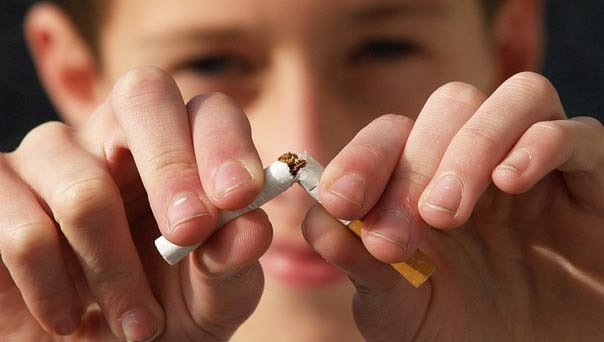
These days, when I read the news, I occasionally come across very welcome statistics. It is the news that the youth smoking rate in the United States is continuously decreasing.
According to the latest report from the Centers for Disease Control and Prevention (CDC), as of 2024, the traditional cigarette smoking rate among high school students is only in the 2% range.
Just over 20 years ago, the figure was over 20%, and now it is not just decreasing but almost 'disappearing'.
When I first encountered this figure, I honestly let out a sigh of relief.
This is because I am also a mother and someone who grew up in a 'smoking household'.
In Korea during the 80s and 90s, it was truly a paradise for cigarettes.
The cigarettes that my father always held in his hand were part of our family routine, and the male protagonists on TV looked cool with cigarettes in their mouths.
Some of my school friends started secretly smoking from high school.
At that time, 'smoking' was seen as a symbol of adulthood and felt like an expression of a free spirit.
Ironically, adults back then would say, "Don't smoke," but there was little awareness about the dangers of smoking.
But now, times are different. Especially in American society, over the past 20 years, it has been one of the most aggressive and systematic countries in terms of anti-smoking policies.
Tobacco advertising has been strictly regulated, and including smoking scenes in movies or TV shows can affect age ratings.
Schools educate about the dangers of smoking early on, and in many states, selling tobacco or e-cigarettes to minors is legally prohibited.
The result is the current youth smoking rate of 2%. It is truly an amazing achievement.
The problem is that while traditional 'cigarette' smoking has decreased, e-cigarette use is still consistently occurring among youth.
For example, in the same survey, about 10% of high school students reported that they still use e-cigarettes.
E-cigarettes are perceived as 'less smelly' and 'less harmful', making them seem like a harmless hobby.
However, the nicotine content is still high, and the risks of lung damage and addiction are clearly present.
Moreover, because they taste sweet and look stylish, they easily appeal to teenagers as a 'cool accessory'.
At this point, I find myself asking a question.
"What kind of generation do we really want?"
Is it simply a generation that does not smoke traditional cigarettes?
Or is it a generation free from the addictive substance nicotine in any form?
Smoking is not just a health issue. It is a comprehensive problem that includes habits, addiction, social influence, and psychological coping mechanisms.
The more stress there is, the greater the loneliness, and the less control one has, the stronger the temptation to smoke becomes.
Therefore, to create a truly smoke-free society, we need not only regulations but also healthy alternatives and a warm community.
And here, the 'family' plays an important role.
Research shows that one of the biggest factors in reducing youth smoking is still 'parental attitude'.
If parents are smokers, their children are more likely to smoke. Conversely, children raised in homes where non-smoking is naturally practiced and a smoke-free environment is maintained are much less likely to smoke.
As someone who once lived in the smoke of my father's cigarettes, I do not want my child to breathe that air.
So when I talk about smoking at home, instead of simply saying, "Cigarettes are bad," I say, "Your body is your most precious friend. Let's not do harmful things to that friend."
This welcome statistic of decreasing youth smoking rates in the U.S. is not just a number.
It is evidence of how long our society has worked to create a 'healthier generation'.
And at the same time, it is a question mark about how we will protect our children, especially in the face of the new temptation of e-cigarettes that we still need to solve.
Still, I believe. A generation without cigarette smoke, a generation free from addiction, a generation that learns to cope with stress healthily will continue to grow.
The beginning will be a change in awareness among us adults and the accumulation of small actions.
Since my husband is also quitting smoking, I want to proudly say one day.
"Cigarettes? We don't have those in our house."





 Magic Cabbage School of Martial Arts |
 Vacation on Hawaii |
 morvex37 |
 Ari Songhan American Immigration Life |
 Bearded Strawberry Smoothie |
 Eldorado 88 |


 Washington Monument |
 heartbreaker |
  US Embassy |
  Korean Mom |
  My NYC |
  moo moo |
  Mr Oh |
  forevergee |
  festival |
  manchester |
  constant |
  Leapfrog Move |
  vibranto |
  Tora Tora |
  yellowbutter |
  Dolly |
  NYC saladbar |
  Finding Superfoods |
  lightyear |
  song bang |
  vexomo |
  Indiana Jones |