

These days, as I watch the news, I often think, "Wow, the world has really changed a lot."
One of the topics is China's space exploration, starting with the story of its space station orbiting Earth.
Have you heard of Tiangong? In the past, when we thought of space, it was always about the U.S. and Russia. But now, it feels like that dynamic is slowly changing. I believe China has surpassed Russia and has entered a new era of space exploration on its own terms.
Tiangong is essentially China's version of the International Space Station. But the key point here is the term "Chinese version."
Unlike the ISS, which was built collaboratively by the U.S., Russia, and Europe, Tiangong is designed, launched, and operated entirely by China, without any outside help. This is a significant difference. While Russia's space technology was impressive in the past, it often relied on the legacy of the Soviet era. In contrast, China is continuously creating new technologies in the present.
As Tiangong orbits and Chinese astronauts live and conduct experiments there, it feels like the training phase is over. They are not just launching once for a photo op; they are running a system that allows them to live and work in space. This is a level of capability that only a true space power can achieve. Russia was once the leader in this field, but these days, its ability to create new stations and expand its technology has slowed significantly.
What is concerning about China is that they are connecting all these dots. Tiangong is not just a space laboratory; it serves as a mid-point before heading to the Moon and Mars. They are training astronauts, testing equipment, and gathering long-term stay data. Based on this, their plans for lunar landings, lunar bases, and further space exploration are becoming very clear.
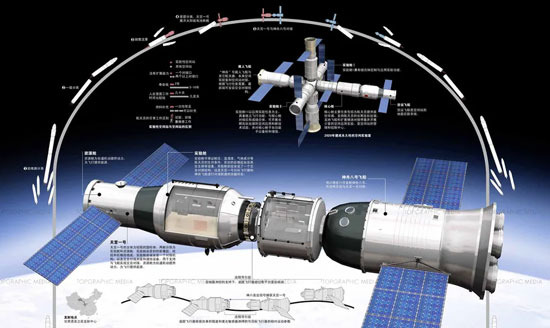
This is where China clearly separates itself from Russia. Russia still seems to be holding on to its past glory, while China is laying out a roadmap for the future and steadily progressing along it. Tiangong is operational, the Chang'e probe has photographed the far side of the Moon, and now they are aiming for a manned lunar landing by 2030. This is all moving like a single space ecosystem.
When you think about it, this is not a distant story at all. Space technology ultimately connects to communications, military, artificial intelligence, and new materials. The technologies tested on Tiangong will eventually come down to industries on Earth. This will also shift the balance of power and economy.
So, when people say, "China has surpassed Russia," it doesn't feel like just a sensational statement. In the field of space, I think it's fair to say they have already surpassed them. How many countries have their own space station, rockets, and astronaut systems?
Now, China has become a space player that must be considered alongside the U.S., while Russia seems to be diminishing in presence between them. Where it used to be the U.S. vs. the Soviet Union, now it is much clearer that it is the U.S. vs. China.
The night sky remains quiet, but a significant game is unfolding above it. Tiangong is like a signal flare, symbolizing that China is saying, "We also deserve a seat at the space table."
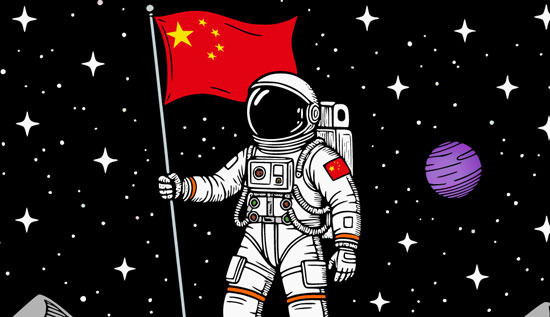
Sometimes, when I take my kids out to stargaze, I think about how we might see the moment when the Chinese flag is planted on the Moon on TV during our lifetime. It's a scene I never imagined before, but now it seems like it could become a reality, which is both fascinating and a reminder that times are changing.





 Korean Mom |
 novapixel |
 Peter Pan Pet |
 horse |
 Sunset Oregon |
 Weekend Movie Blog |
 Beauty, Health, Lifestyle Blog |
 coloradoman |
 Superman Cat Blog |
 US Embassy |
  My NYC |
  moo moo |
  Mr Oh |
  forevergee |
  festival |
  manchester |
  constant |
  Leapfrog Move |
  vibranto |
  Tora Tora |
  yellowbutter |
  Dolly |
  NYC saladbar |
  Finding Superfoods |
  lightyear |
  song bang |
  vexomo |
  Indiana Jones |