

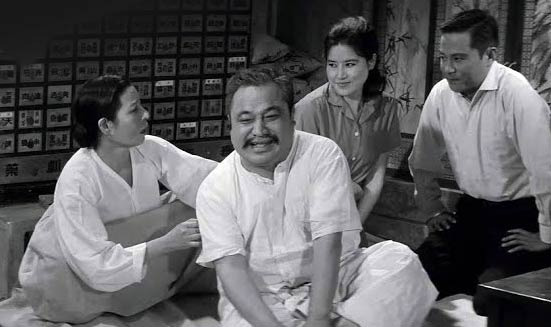
While watching YouTube, I happened to see the classic film 'Under the Roofs of Seoul' produced by Shin Sang-ok and directed by Lee Hyung-pyo from 1961.
Honestly, I watched it without much expectation since it's an old black-and-white film over 60 years old, but the acting of Kim Seung-ho stood out as exceptional.
Even by today's standards, his performance was not awkward at all; it was so natural and charming that I could feel the depth of his acting skills.
Despite being an old film, his pronunciation was clear and his emotional delivery was precise.
It was a moment that shattered the preconceived notion of actors during the Liberal Party era.
In the film 'Under the Roofs of Seoul', Kim Seung-ho plays Kim Hak-kyu, the head of a family running a traditional medicine clinic.
However, he is in turmoil as he loses patients to a newly opened modern obstetrics and gynecology hospital across the street.
Even with this simple setup, the character's personality is vividly portrayed. He is proud and stubborn, yet the anxiety of being the breadwinner for his family is also evident.
His disapproval of his daughter Hyun-ok's relationship with the obstetrician and his opposition to his son Hyun-gu's marriage due to class issues reflect the societal norms of that time, adding a strong sense of realism.
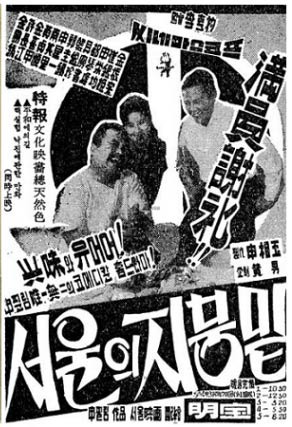
To understand the political backdrop of Korea in 1960-61, we must first look at the situation of that time.
The person in power during that period was Syngman Rhee. He was the first president of the Republic of Korea, having maintained a long-term rule since 1948, until he finally stepped down in 1960.
The presidential election held on March 15, 1960, is still regarded as one of the most notorious fraudulent elections in modern Korean history. This is where the so-called 'Liberal Party thugs' come into play.
At that time, the Liberal Party went beyond being a simple political party and even utilized violent organizations to maintain power. They threatened voters at polling places, assaulted opposition figures, and forcibly dispersed protesters. By today's standards, their actions were almost akin to paramilitary behavior.
This violence ultimately sparked public outrage. In particular, protests that began in Masan spread nationwide, leading to the April 19 Revolution. Students and citizens poured into the streets, and as police opened fire, casualties occurred, escalating the situation uncontrollably. Eventually, Rhee declared his resignation and went into exile in Hawaii.
Then in 1961, the May 16 military coup occurred, bringing Park Chung-hee to power. From this point, Korea entered another authoritarian regime. The years 1960-61 were the most tumultuous period in modern Korean history, marked by fraudulent elections, political thuggery, citizen revolutions, and military coups all happening in a short span of time.
Thus, the 1961 film 'Under the Roofs of Seoul' serves as a record that closely captures the realities of ordinary people living through such a turbulent era.
At that time, Korean society was undergoing massive changes, from fraudulent elections and political thuggery to citizen revolutions and military coups. While power was in turmoil, most people had to focus more on their daily survival amidst such grand shifts.
Through the story of Kim Hak-kyu's family in the film, one can feel the atmosphere of that era. The struggle for survival makes them sensitive to competition, family conflicts arise from pride and stubbornness, and the younger generation clashes with their parents over new values. Therefore, this film presents the lives of ordinary people more directly than grand historical explanations. Of course, political or regime discussions do not come up in the film.
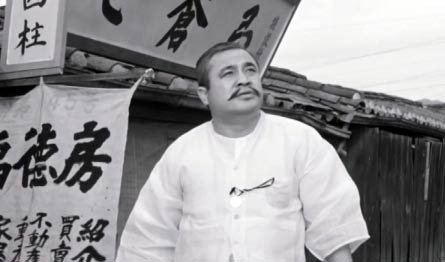
In this film, Kim Seung-ho portrays a stubborn head of the family who, after running for election and losing all his wealth, collapses and ultimately acknowledges his mistakes, all while his performance remains grounded and true to the character. This allows the audience to go from hating him to ultimately understanding him.
Kim Seung-ho was born in 1918 in Cheorwon, Gangwon Province, and grew up in Seoul. His acting career began at Dongyang Theater, and he later entered the film industry with 'Liberty or Death'.
For a while, he played minor and supporting roles, but in 1956, he reached a turning point by taking on the role of Maeng Jin-sa in the film 'The Day of the Wedding'. This work earned him an award at the Tokyo Asia-Pacific Film Festival, marking the beginning of his rise to fame.
His filmography is nothing short of explosive, featuring over 250 films, including works like 'The Coachman' and 'Romance Papa'.
Notably, in 'The Coachman', he became the first Korean actor to win the Silver Bear at the Berlin International Film Festival, marking a significant moment in Korean film history.
What I felt after watching Kim Seung-ho's performance was one thing: acting transcends time. While techniques and filming methods may change, the essence of acting that persuades people remains unchanged.
There's a reason why it's considered a classic. Nowadays, some actors' performances can feel excessive, but Kim Seung-ho's acting is both simple and profound.
Kim Seung-ho's final story captivates as much as his acting. He passed away in 1968 at the age of 50, still in the prime of his career.
By today's standards, that seems far too early. What's even more astonishing is the words he reportedly left behind before his death: "I still have acting to do; it's unfair to die now."
At that time, Kim Seung-ho was one of the busiest actors in the Korean film industry, continuing his peak while fully matured in his craft.
The arrival of death at such a moment was difficult for him and those around him to accept. It wasn't just about the age; there were still so many roles and stories he could have portrayed. Thus, his last words were not merely an expression of emotion but rather a testament to his dedication as an actor.
It was a candid confession from someone who still had more acting to show and more life to live. Perhaps that's why the actor Kim Seung-ho is remembered for so long. He was someone who, even at the end of his life, had lingering attachments to acting. That was Kim Seung-ho.
When you have time, it might be a meaningful experience to explore his other works one by one.
 OldGranduer
 SquidCap
 NakdongHyori




 vegas mom |
 Coco and Lulu |
 There Are Such Things in the World |

 Seattle - Emerald City |
 Living with a Consistent Heart |
 Dallas Fort Worth DFW |
 Central Intelligence Agency Deputy Director |
 U.S. Weather Bureau News |
 Texas Migration Story |
  Good News Good Thoughts |
  peelynew |
  Helpful Life Stories |
  chicpo |
  monorama tone |
  Kentucky Fried Chicken |
  bloomberg |
  morninpo |
  my town K blog |
  bravik31 |
  Various Knowledge and Information in the USA |
  orvik90 |
  San Gabriel Mountains |
  quanta7 |
  Fransco Family |
  leonee |
  Augusta 90 |
  Project Tomorrow |
  DOCTOR MED |
  Say IT Now |