

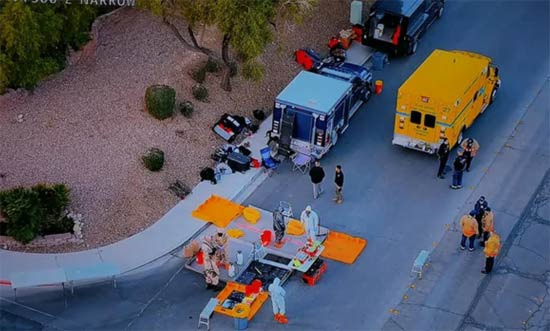
After struggling for over three years with the coronavirus, it seemed like we could finally take a breath, but news of a Chinese-backed bio lab has emerged. The illegal bio lab incident uncovered in Reedley, CA, along with a similar case found in Las Vegas, Nevada, clearly illustrates the gaps in U.S. health security.
What's more alarming than the containers labeled with pathogen names or the lab mice themselves is the fact that there were clear warning signs, yet the system failed to function properly. The reality that a typical residential garage and storage space could be transformed into a deadly experimental site is no longer just a hypothetical scenario.
The facility first discovered in late 2023 in the small city of Reedley, Fresno County, appeared to be just an ordinary residential storage shed from the outside. However, inside, there were containers labeled with various pathogens and a large number of lab mice, and the basic concepts of hygiene and safety were completely disregarded. It's chilling that there was no boundary between the living spaces of residents and hazardous materials.
Before the shock of this incident could even fade, a nearly identical facility was found in a Las Vegas neighborhood, leading to the realization that this was not just a simple occurrence. Personnel in protective gear and even robots were deployed to the scene, and unidentified samples were sent to national analysis agencies in the East. This indicates that authorities were aware this was a serious matter.
The commonality between the two incidents is that they utilized private property rather than large research facilities. While regulations are stringent for established research facilities, they operated slowly and insensitively in the face of small illegal facilities exploiting personal spaces. The most discussed aspect has been the federal response.
Local authorities requested assistance multiple times from the beginning, but the feedback received was often lukewarm. Confusion surrounding the responsibilities and response speed of federal agencies, including the CDC, further heightened residents' anxieties. Although warning signs were clearly present, there was no visible control tower to manage the situation, allowing the illegal facilities to buy time.
The most uncomfortable question raised by these incidents is a very simple one: Is our daily life truly safe? When spaces that should protect individual privacy can threaten public safety, is there enough mechanism in place to detect and prevent such threats in advance? As information becomes more limited, conspiracy theories and fears grow, and citizens are often the last to learn about the situation.
This incident is not just past news; it serves as a warning. We need to reduce jurisdictional disputes between federal and local authorities and establish a system that can respond immediately to warning signs. Management of bio equipment and reagent distribution must also be strengthened to align with reality.
Above all, transparency is crucial. Without fast and clear information sharing, similar stories are likely to erupt again from another garage in another city.
The worrying reason is that if problems continue to emerge while the response system remains unchanged, catastrophic news is just a matter of time.







 Moscow Kim |
 coloradoman |
 Montgomery Mom |
 GOGO SING |
 Hajiwon Blog Hair Salon |
 Famous Attractions in the United States |
 Rowland Mama |

 People Moon |
 U.S. Military Recruitment Information |
  Korean Mom |
  My NYC |
  moo moo |
  Mr Oh |
  forevergee |
  festival |
  manchester |
  constant |
  Leapfrog Move |
  vibranto |
  Tora Tora |
  yellowbutter |
  Dolly |
  US Embassy |
  NYC saladbar |
  Finding Superfoods |
  lightyear |
  song bang |
  vexomo |
  Indiana Jones |