

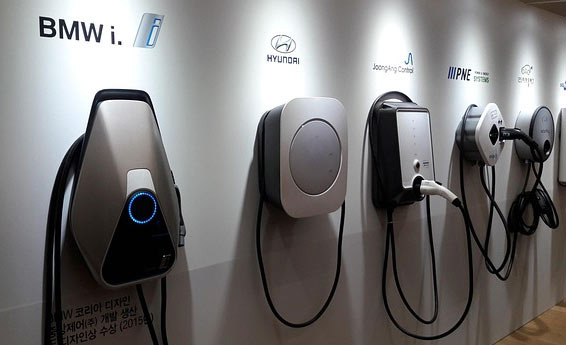
These days, electric vehicles are increasingly seen on the streets of America.
In my neighborhood alone, 2-3 electric cars pass by in succession, and while waiting at the traffic light, both sides of me are electric vehicles.
However, there is an unspoken war in the world of electric vehicles.
It's the charging plug battle.
We think, "Electric vehicle? Just charge it," but in reality, it's as complicated as the battle between USB-C and Lightning.
And now, the conclusion is slowly coming to light.
Tesla created its own 'world' from the beginning.While everyone else was using CCS, Tesla developed its own standard, the NACS, and set up a network of dedicated Supercharger fast charging stations.
There were criticisms like, "Why isn't everyone doing it together?" but Tesla responded,
"Why should I? Mine is faster, slimmer, and more efficient!"
And it was indeed the case.
There are over 30,000 Tesla Superchargers installed in the U.S., they are reliable, and the user interface is clean.
In other words, it was the Apple of electric vehicles.
So what were other car companies doing?
In the beginning, they adhered to the CCS standard.
Most brands, including Ford, GM, Hyundai, Kia, Mercedes, and Volkswagen, used CCS charging ports and partnered with private charging networks like EVgo.
The problem was?
These systems were often faulty, app connections were problematic, and charging speeds were inconsistent.
I was frustrated waiting, and so were those charging,
but in the meantime, Tesla users would charge smoothly at Superchargers and leave coolly.
At this point, it was inevitable that someone would say, "Hey, let's use those charging stations too."
In 2023, a significant event occurred.
Ford was the first to shout.
"We will include Tesla's NACS port from now on!"
GM quickly followed with, "We will implement it even faster!"
Hyundai, Kia, and Mercedes also made similar announcements.
Ultimately, starting in 2025, almost all manufacturers will have NACS ports as standard and will be able to access the Supercharger network.
This moment goes beyond just a charging plug issue; it was the moment when the center of the electric vehicle ecosystem shifted to Tesla.
In short, Tesla has won decisively in the charging standard.
In fact, this is good news for ordinary consumers like us.
It reduces confusion, increases the number of charging stations, and provides more options.
The fact that non-Tesla vehicles can also use Superchargers is a significant change.
Of course, CCS charging stations still exist, and there may be some confusion during the transition, but the direction is almost set.
In the future, when buying an electric vehicle, you might not even need to ask, "Is this NACS?"
It will just be included as standard.
Sticking to its own standard, it has now become the norm.
However, it's not just Tesla that has benefited.
Now Ford, GM, and Hyundai can also use Superchargers, enhancing consumer accessibility, making it a true win-win.
So looking at the current electric vehicle market... a peace treaty for chargers has been signed.
Now, what matters more than the charging war is whether there is a level 2 charging outlet in my garage.



 eatontown blog |
 Toaster Pizza Magic Show |
 US Embassy |
 fortbliss |
 Folding Instructions |
 Purple Moons, |
 Korean Mom |
 What can make money? |
 Information on All Regions of the United States |
 Finding Superfoods |
  Tonky |
  viroma |
  cookie |
  Live and that's it |
  Alright Twain |
  HAWAII Korean Church News |
  Amore |
  linex |
  Balancework |
  laro90 |
  MEDBIO American Doctor Blog |
  SWAT TEAM BLK |
  DREAM BIG |
  frostbite |
  330 Forever My Love |
  El Dorado |
  dralix58 |
  Gorama Round |
  Skydiving |