

At first, it sounds ridiculous, right? The first reaction is often, "Wait, can they really be connected as one region?"
However, if you spread out a map and look closely, it starts to shift from mere imagination to, "Oh, this could actually happen."
Currently, San Antonio and Austin are perceived as separate cities.
San Antonio has significant military facilities, a strong medical complex, and a clear tourism-based economy.
In contrast, Austin is home to the state government and has a strong image as a tech and startup city.
But just because they have different characteristics doesn't mean their living areas are separate.
The distance between the two cities is just over an hour by car, and during peak travel times, it can be as quick as 45 minutes. The key point is that this stretch is no longer an "empty gap" like it used to be.
As you drive down I-35, areas that were once just passed through are now filled with housing developments, shopping centers, warehouse stores, and newly constructed roads. In simple terms, the cities are reaching out to each other, and the space in between is already feeling like it's glued together.
Population movement is solidifying this connection even faster. Austin's housing prices and cost of living have risen so quickly that people who work in Austin but can't afford to buy a home are starting to move south. This is particularly true for areas just north of San Antonio or in between.
Conversely, more and more people are commuting from San Antonio to Austin. In the past, hearing about that would elicit a response of, "Wow, you do that every day?" but nowadays, the sentiment has shifted to, "That makes sense."
Jobs are in Austin, while homes are in northern San Antonio or somewhere in between. This pattern closely resembles the past situation of Dallas and Fort Worth, which were once separate but eventually became intertwined as a single living area.
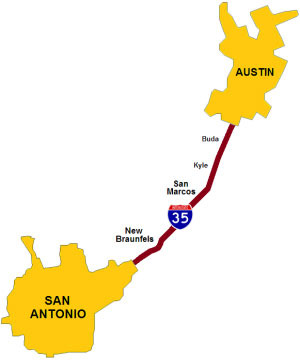
Currently, San Antonio and Austin are somewhere in the middle of that process. From a business perspective, this structure is more attractive. Austin has a wealth of talent, a strong brand, and a tech image, so companies want to put their front signs in Austin. However, the costs are significant.
Thus, there is a growing trend to place logistics, back-office, and operational organizations in relatively lower-cost San Antonio or the areas in between. Amazon is doing this.
When hiring, the approach is shifting to, "Let's not just look at Austin, but also consider San Antonio." This is because merging the living areas creates a sudden increase in the talent pool.
Additionally, the infrastructure, such as airports, highways, universities, and military facilities, is not concentrated on one side but is distributed on both sides, which is a strength.
So when you look at Central Texas, the calculation shows, "It has scale, money is circulating, the population is continuously growing, and the roads are already in place."
Of course, the two cities won't completely blend into one like they are the same city. San Antonio has its own distinct character, and Austin has a strong culture of its own. However, as time goes on, the sense of identity may shift from "I am an Austinite" or "I am a San Antonian" to "I live in this Central Texas metropolitan area."
When commuting, housing, shopping, and jobs all operate within the same framework, people's mental maps will change. This transformation is still in its early stages.
So, it may not be surprising if one day San Antonio and Austin are referred to as "one metropolitan area" like DFW.







 moo moo |
 ultron78 |
 garlic bread |
 Sugar Cream Door Bulletproof Noodles |
 urbanmint |
 quanta7 |
 Living with a Consistent Heart |
 |
| 
 U.S. Weather Bureau News |
 Dallas Fort Worth DFW |
  DREAM BIG |
  frostbite |
  330 Forever My Love |
  El Dorado |
  dralix58 |
  Gorama Round |
  Skydiving |
  dreamport |
  Yellow Snowman |
  Toaster Pizza Magic Show |
  velvetnom |
  Anytime Journey |
  Mrs. Duluth |
  jaxter |
  Atlanta Mama |
  Baguette Blog |
  Tan Sol |
  US Embassy |
  Korean Mom |
  My NYC |