

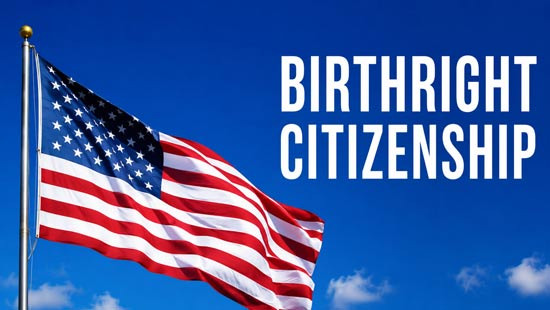
Have you heard of the system that automatically grants U.S. citizenship to children born in the United States? It's known legally as 'jus soli.'
For Koreans, this is quite a fascinating system. South Korea follows 'jus sanguinis,' which means citizenship is based on the nationality of the parents, not the place of birth.
For example, if an American couple has a child while traveling in Seoul, that child does not become Korean. Instead, they inherit their parents' American nationality.
However, the U.S. is completely different. Until now, regardless of whether the parents are students, tourists, or even undocumented immigrants, as long as a child is "born on U.S. soil," they are guaranteed U.S. citizenship. This is also why 'birth tourism' became a significant social issue in Korea.
Recently, though, this rule that has been in place for over 150 years is being challenged.
President Trump signed an executive order stating, "If the parents are not U.S. citizens or permanent residents, we will not grant citizenship to children born in the U.S."
In other words, he declared that "the era of everyone born on U.S. soil automatically becoming American is over."
However, this is not as simple as it sounds. There is a significant barrier: the 'U.S. Constitution.'
The 14th Amendment of the U.S. Constitution clearly states, "All persons born in the United States are citizens." This has been a fundamental principle upheld by U.S. courts for over 150 years.
No matter how powerful the president is, he cannot override the Constitution, so legal experts believe that "no matter how much Trump tries, this executive order will be deemed invalid."
In fact, this case has reached the Supreme Court, and even the conservative justices are cautious about altering the Constitution.
Interestingly, when viewed globally, South Korea's approach is much more common.
Countries like South Korea, Japan, and China, as well as most European nations such as Germany and Italy, follow the nationality of the parents.
In contrast, the U.S. and Canada, which grant citizenship based on the place of birth, are considered unique 'outliers' in the international community.
It seems unlikely that the U.S. will change to a system like South Korea's anytime soon.
Unless the Supreme Court makes an unprecedented decision to overturn constitutional interpretation, the formula of 'birth in the U.S. = citizenship' will likely remain in place for the foreseeable future.
However, one thing is certain: the era when the U.S. welcomed "any immigrant with open arms!" is over.
As of 2026, the threshold for South Koreans to enter the U.S. is much higher and more challenging than expected. The biggest barrier is the inequality of the 'visa system.'
Countries like Australia and Singapore have free trade agreements (FTAs) with the U.S. that provide special work visa benefits, but South Korea has no such quota, leading to fierce competition in the annual lottery.
Many young people return home after completing their studies because they cannot obtain an H-1B work visa, and it takes years and significant costs to gain permanent residency. Additionally, the recent anti-immigrant sentiment in the U.S. is further narrowing this already small window.
Investment immigration (EB-5) also requires substantial funds, making it unattainable for ordinary workers. Many dream of the American Dream, but the increasingly stringent qualification assessments and instability of status have led to the saying that "immigrating to the U.S. is a miracle that requires luck, money, and time."
In any case, the outcome of this trial will likely serve as an important indicator of what doors the U.S. may lock in the future, beyond just the possibility of birth tourism.
 OrangeMaker
 ChocoWalker
 DreamMaker







 U.S. Retirement Pension Information |
 California Dreamer |
 NEXT ROUND |
 US Economic Financial News |
 There Are Such Things in the World |
 Happy Together 213 |
 Superman Cat Blog |
 Sunny's Travel in America |
 Texas Real Estate Blog |
  Seattle - Emerald City |
  Texas Migration Story |
  Unknown Dog Walk blog |
  Bearded Strawberry Smoothie |
  JESIKYEOALBA BLOG |
  Heart Ticker |
  Jellia Angel |
  Moo Tang Clan |
  Khan Film Blog Production |
  yenne |
  neroyo |
  Peter Pan Pet |
  solvix18 |
  Next Year, Let's Become Rich |
  Investment Campus Home Ownership |
  virex |
  Yoyma |