
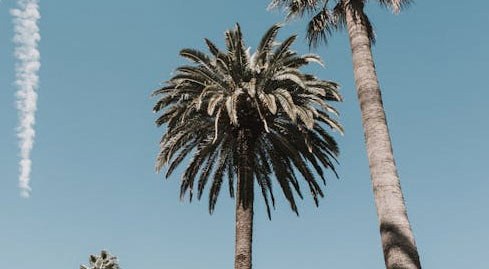
First-time visitors to LA are often captivated by the postcard-like scenery created by the towering palm trees, making them feel, "This is California!" However, these days, the local media and urban planners frequently discuss the 'palm tree debate.' Let's explore why this conversation is emerging from five different angles.
A Symbol, But Not Native
The Mexican fan palms and Canary Island date palms that fill most streets in LA are not actually native species. They were brought by Spanish missionaries and were heavily planted during the 1930s in preparation for the Olympics, resulting in a 'tropical image' being painted over the city. The only truly native species is the Washingtonia palm, which grows naturally in the southern Mojave Desert, leading to concerns about the surprisingly low ecological connectivity.
Cannot Provide Shade or Save Water
In a heat island city where temperatures approach 40 degrees every summer, trees should create shade with their broad leaves to lower walking temperatures. The problem is that while palm trees are large, their shade is small. Moreover, they consume a significant amount of water during their early years, leading to complaints in drought-stricken LA about them being "water-consuming columns." Urban forestry experts suggest that "if we are going to plant new trees, broadleaf and desert shade trees would be more climate-adaptive."
Vulnerable to Fire and Pests: 'Towering Fuel'
The palm trees, with their layers of dry leaves, act as a 'fuel ladder' when wildfires spread. Reports indicate that during the large wildfires of 2024-25, dozens of dried palm trees sent embers soaring into the air, exacerbating the spread. Additionally, invasive pests like the red palm weevil and fungi have led to a surge in the number of dead trees.
City Budget: A 'Bottomless Pit'
Currently, it is estimated that about 100,000 palm trees remain in streets and parks. Even replacing just a few for 'icon maintenance' after cutting down dead trees costs millions of dollars annually. The city of LA has already established a policy of "not replanting dead palms" and is redirecting its budget towards planting native shade trees like live oaks and desert willows. Projections suggest that by around 2035, the number of palm trees in urban areas will be reduced to less than half.
Cultural Assets That Cannot Be Erased
The Hollywood backdrop, beach sunsets, and palm-lined streets are quintessential to the LA brand. The tourism industry and some residents propose a compromise, suggesting that "instead of removing all, we should at least preserve symbolic sections." In fact, the city is considering maintaining "commemorative palm trees" in iconic areas like Hollywood and Wilshire Boulevard by selecting pest-resistant varieties.
In other words, the palm tree has completed its role as an "influencer that introduced LA to the world," and now it is time for it to step back.




 Weekend Movie Blog |
 Beauty, Health, Lifestyle Blog |

 coloradoman |
 Superman Cat Blog |
 Noodle Noodle |
  Tonky |
  viroma |
  cookie |
  Live and that's it |
  Alright Twain |
  eatontown blog |
  HAWAII Korean Church News |
  Amore |
  linex |
  Balancework |
  laro90 |
  MEDBIO American Doctor Blog |
  SWAT TEAM BLK |
  DREAM BIG |
  frostbite |
  330 Forever My Love |
  El Dorado |
  dralix58 |
  Gorama Round |
  Skydiving |