
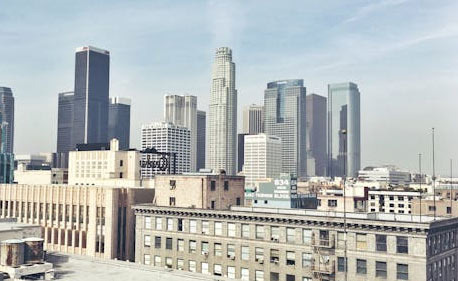
People in Downtown LA refer to the fashion district as the "Jobber Market."
The English term Jobber Market (the street of jobbers who sell fabrics in small quantities) has solidified into 'Java' in the mouths of Korean immigrants.
Today, we will summarize the origins of this alley, the heyday when Korean merchants took the lead, and the future landscape that will change under the DTLA 2040 plan.
The Era of the "Garment District"
In the 1920s, the Cooper Building and Fashion Center Building were established, and clothing warehouses and showrooms began to flood the area around 9th Street and Los Angeles Street. By 1972, the LA Times reported that "2,000 manufacturers are gathered here," leading to the nickname 'Garment District.' Due to the nature of the clothing industry, where quick turnover is essential, the jobber culture of taking small amounts of fabric and immediately turning it into clothing naturally took root.
The Birth of 'Java' and Korean Immigrants
In the late 1970s, Korean merchants who crossed over to LA via Central and South America found a niche in this market, which was dominated by Jewish merchants. They captivated buyers with "ultra-speed production" that reflected trends by quickly sourcing cheap fabrics and producing samples within 24 hours, and at this time, the jobber market began to be referred to as 'Java' in Korean pronunciation. As of 2015, it is estimated that one-third to half of clothing, fabric, and accessory stores are Korean-owned, with annual sales reaching $10 billion and employment reaching 20,000 people.
The Light and Shadow of the Heyday
Fast fashion giants like Forever 21 sourced products from the Java Market, and successful first-generation merchants bought buildings in Koreatown with the money they earned, leading to the saying, "Java fed Koreatown." However, after the late 2000s, overseas production surged, and with rising wages and regulations, manufacturing jobs decreased to less than half over 20 years. A major federal money laundering crackdown in 2014 and the pandemic shock in 2020 marked significant blows, prompting some businesses to consider relocating to El Paso, Texas, where taxes and labor costs are lower.
DTLA 2040 and BID
However, the market is not disappearing. The DTLA 2040 plan, passed in 2024, aims to double the residential land in downtown and build 100,000 housing units over 20 years. In line with this, the Fashion District BID announced plans for "mixed-use development combining residential, office, showroom, and retail" and the creation of pedestrian-friendly streets, with a target for 2024-25 to expand security and cleaning personnel. Small fabric shops and sewing factories are also transitioning to online ordering and small-batch production (micro-factories), regaining competitiveness with quick delivery and low-carbon supply chains.
E-commerce & The Laboratory of Sustainable Fashion
After the pandemic reduced buyer traffic, merchants expanded their sales channels through TikTok and Instagram live sales, and introduced ultra-short reorder systems like "same-day samples to mass production within 3 days." At the same time, the increase in upcycled fabrics and resale showrooms has earned the area the reputation of being a "laboratory for sustainable fashion." The BID trend report states that "35% of vacant stores have reopened with resale and eco-friendly concepts since 2023."
Ultimately, the Java Market is evolving from a "huge garment factory complex" to a "ultra-short design and manufacturing platform."
Amid the waves of change, the DNA of being "the place that makes trends into clothing the fastest" remains intact, which is the true competitiveness of the Java Market, isn't it?








 Weekend Movie Blog |
 Beauty, Health, Lifestyle Blog |
 coloradoman |
 Superman Cat Blog |
 novapixel |
  US Embassy |
  Korean Mom |
  My NYC |
  moo moo |
  Mr Oh |
  forevergee |
  festival |
  manchester |
  constant |
  Leapfrog Move |
  vibranto |
  Tora Tora |
  yellowbutter |
  Dolly |
  NYC saladbar |
  Finding Superfoods |
  lightyear |
  song bang |
  vexomo |
  Indiana Jones |