
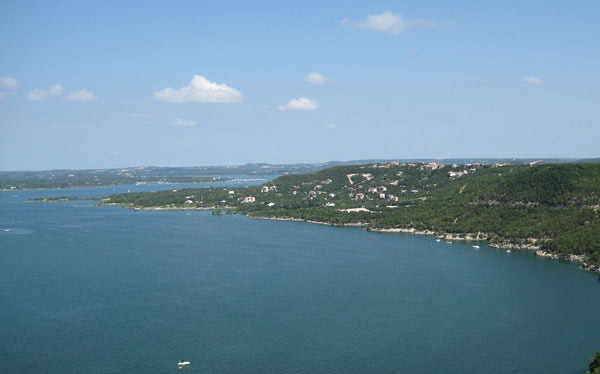
Lake Austin, which extends north of Austin, has quite an interesting history.
Although it is called a lake, it is essentially a long reservoir created by damming the Colorado River. In the days when the water flowed naturally, it was just a river, but in the early 1930s, the Texas Power Company began building a dam to generate electricity, leading to the formation of Lake Austin as we know it today. So, it can be seen as a waterway that was altered by humans before nature.
Initially, the dam was not as sturdy as it is now, and during major floods, the water would overflow and the hydroelectric plant would stop operating. Later, with the construction of the Mansfield Dam, management became stable and water level control became easier. Since then, this lake has transformed from a simple water reservoir into a playground for the people of Austin. Stretching long like a river yet calm like a lake, it has rows of expensive waterfront homes.
Let's talk about the water quality of Lake Austin. The water here is not always perfectly clean, but it is not at a level where you would say, "It's dangerous to go in." Overall, it can be considered relatively good water. However, one should not be complacent. There are times when the oxygen levels in the lower sections of the lake drop, making it a less favorable environment for fish and aquatic life.
Especially in the summer, the swimming season opens up. Unlike Lady Bird Lake, Lake Austin allows swimming, so you often see young people floating on tubes and playing music. However, since boats are around, you need to check the safe zones before entering.
Interestingly, this lake was originally built for power generation and flood control, but over time it has become more famous as a recreational space. As Austin has grown and people have become tired of city life, they naturally gather by the water. Nowadays, many people come to fish, and it is especially known as a bass fishing hotspot.
When you float on the calm water, the city noise fades away, and when the sunlight sparkles on the waves, it feels like your mind is settling down. Looking up, you see large houses on the mountainside, people barbecuing on their decks, and dogs playing by the water — it really feels like a movie.
Ultimately, the history of Lake Austin is a story of 'a river aging and changing alongside the city.' Created for electricity and flood control, it has gradually become a place of relaxation for people, and now it symbolizes the water lifestyle of Austin. It can be said to be a landscape created by both nature and humans.
Sometimes, when I go with my kids and sit by the water with a picnic lunch, I really enjoy the sound of boats passing by in the distance and the smell of water carried by the breeze.








 |
| 
 U.S. Weather Bureau News |
 Living with a Consistent Heart |
 quanta7 |
 Dallas Fort Worth DFW |
  forevergee |
  festival |
  manchester |
  constant |
  Leapfrog Move |
  vibranto |
  Tora Tora |
  yellowbutter |
  Dolly |
  US Embassy |
  NYC saladbar |
  Finding Superfoods |
  lightyear |
  song bang |
  vexomo |
  Indiana Jones |
  meloncat |
  novapixel |
  mortrix |
  Esther 1983 |