

Just a few years ago, she was inaugurated as president, receiving countless congratulations, and her travels abroad alongside world leaders were featured in the news every day.
At that time, many people probably thought this couple would be remembered for a long time in the highest positions of power in South Korea.
However, as time passed, the situation changed completely. It reminds us how cold the world of politics can be and that power cannot last forever.
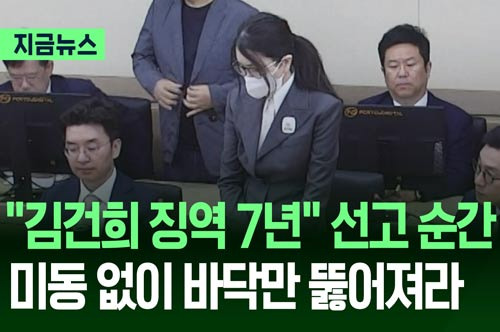
Ultimately, the Seoul Central District Court sentenced Kim Geon-hee to 7 years in prison and a fine of 64.8 million won.
Although this was slightly less than the 7 years and 6 months sought by the special prosecutor, the court found that most of the gifts were given with expectations of favors and quid pro quo.
Reading the judgment is even more frustrating.
The court pointed out that she "received expensive items that are hard to obtain even once in a lifetime without hesitation."
Furthermore, it determined that this was not merely about receiving gifts but that it undermined the fairness and trust of public decision-making.
This is important because the core of this ruling is not just about receiving luxury items.
The court examined why businesspeople gave such expensive gifts and what their intentions were.
The necklace worth 50 million won was deemed to have been given with the expectation of influence in business activities, while the gold turtle and replica of the Sehan were seen as rewards related to requests for favors.
The luxury watch worth nearly 40 million won was also considered difficult to view as a social gift unrelated to presidential office business.
The most surprising was the artwork valued at 140 million won.
How many people would simply gift a painting worth over 100 million won to a friend?
The court also found it hard to view this as a goodwill gesture without any expectations.
The Dior bag and Chanel cosmetics that frequently appeared in the news were similar.
Ultimately, the court concluded that most of the gifts were not just about friendship but were payments for favors.
What's even more frustrating is that the court mentioned the defendant's attitude.
As the investigation began, some claimed they were borrowed, others said they were tokens of gratitude, and later they claimed they were returned, trying to evade responsibility.
Even in court, it was noted that there was no genuine remorse.
This part made me tilt my head in confusion.
If there was a mistake, acknowledging it and taking responsibility might have somewhat eased the public's anger.
However, if the claims continued to be "it was a gift" or "it was goodwill," the public could only feel more bitter.
In fact, the most important aspect of this case is not just the issue of a specific individual.
The larger problem is that there is still a culture in our society where giving expensive gifts to those in power is believed to resolve issues.
Especially for many who supported the conservative camp, there may be a greater sense of disillusionment.Having regained power with great difficulty, many may feel that the entire conservative camp has been affected by this incident.
In the end, neither power, popularity, nor honor is eternal. It seems to remind us once again that the moment you lose the trust of the people, everything can change in an instant.
We really don't know how the world works. Just because you are at the top today doesn't guarantee you will be there tomorrow.
Therefore, the more power you have, the more humble you should be, and you should reflect on yourself with stricter standards.
 vibeforestbuilder1984
 StoryAunt
 SbuxPaik







 Panorama Kstar |
 Giant Squid and Sweet Potato Soup |
 Lol Life |
 lavender |
 logger |
 Victory 1988 |
 There Are Such Things in the World |
 Anjollinya Blog |
 Lightning Sikhye Cooking Method |
 Investment Campus Home Ownership |
  Coco and Lulu |
  Baguette Blog |
  washington mom |
  yorvik12 |
  HVAC will prosper |
  mortrix |
  MAX009 BLOG |
  K-POP TV News |
  My Beloved Hometown Hwagae Market |
  Tart Tart |
  Min's blog |
  Tora Tora |
  pixel77 |
  cuteasducks |
  Lemon Kim |
  What can make money? |
  An ant castle |
  Haha and Bomi Blog |
  glenview 89 |