

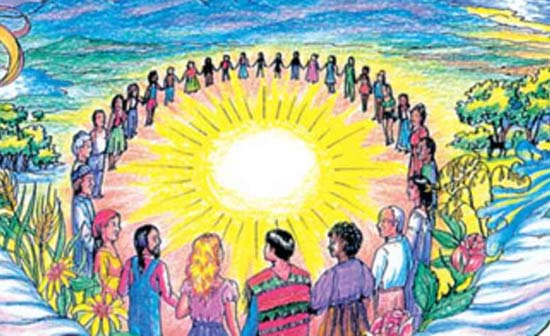
According to statistics from South Dakota, about 3% of the state's population follows New Age religion or similar spiritual movements.
While that number may seem small, considering the overall population of South Dakota is not large, it represents a significant proportion.
The problem is, when you ask what this New Age is, it becomes incredibly vague. There are no scriptures that can be definitively stated as "this is the belief," no denominations, and no specific followers.
On the positive side, it can be described as a free and open spirituality... but honestly, to a Korean, it feels like a jumble of unorganized beliefs.
What exactly does New Age believe?
Nature, energy, the universe, chakras, reincarnation, vibes... it attaches all the good words.
It does seem impressive. Wisdom from Himalayan monks, Indian meditation, angel cards, healing crystals, horoscopes—all bundled under the name "spiritual."
Just when you think, "Oh, that sounds plausible?" a moment later, the question arises, "So what's the core?"
Is there a God or not? How do you believe in an afterlife? What do you see as the purpose of human existence? The answers vary from person to person.
You could say that acknowledging differences is philosophy, but if it's a religion, shouldn't there be at least a minimal framework?
Interestingly, New Age faith always introduces itself with phrases like "the harmony of science and spirituality," "cosmic waves," and "energy alignment." It sounds great, but when you start asking what it really means, it suddenly shifts to "you just feel it, you can't explain it."
Holding a crystal purifies the mind, listening to music at a specific frequency opens angel guides, and resonating with the universe during meditation brings answers to life... that's the gist of it. To be honest, for tired modern people, the phrase "don't think, just feel" is quite sweet.
The problem is, that's where it ends. Believers say it exists, and if you don't feel it, they shift the blame by saying, "your vibes are too low." At this point, verification becomes fundamentally impossible.
South Dakota is originally a land of deep faith. Indigenous people have lived in connection with nature and ancestors, while settlers from the pioneer era built churches centered around Christianity. It's somewhat natural for such a region to be drawn to New Age.
The land is vast, the sky is deep, and the wind invites contemplation. There's a lot of loneliness, and as people get closer to nature, they tend to think about the invisible.
The issue is that this spiritual world sometimes combines with business, turning into a 'spiritual market.' Selling crystals, offering meditation sessions, selling tickets for energy purification workshops... the moment money exchanges hands, religion becomes a product rather than spirituality. The pattern of wallets getting lighter under the guise of healing is something we've seen before.
Of course, for someone, New Age might be a source of comfort. In moments when life falls apart, meditation and rest in nature can be helpful, and some may want to choose a flexible belief away from the rigidity of religion. It cannot be condemned outright.
But to speak coldly, there are many gaps in calling a "seemingly existent yet non-existent belief system" a religion. It feels more like repeating pleasant words rather than providing direction in life. The approach of "if you believe, it's right, and if you don't, it's your fault" is convenient. No one is wrong, but that also means no one is responsible.
Ultimately, New Age seems to be a shadow of a modern faith that has oddly taken root in the land of South Dakota. A flow created by the meeting of nature-worshiping sensibilities and psychological healing language. However, belief needs a center, and if it's a religion, it should at least be able to be summarized in one line.
It's fine for everyone to believe differently. But if it's a religion, shouldn't it be a pillar that supports life? With just light inspiration and emotion, it's hard to withstand when a storm blows. New Age may look cool at times, but when you try to grasp it, it's like trying to catch air. It feels good, but it lacks depth, and it's a faith that is warm yet lacks a backbone.
So, while 3% may believe, there might be a reason it's a bit lacking to grow beyond that.







 novapixel |
 Peter Pan Pet |
 horse |
 Sunset Oregon |
 daisypat |
 Dreams Come True as Desired |
 Dakota Man Blog Thanks |
 Mr. Midwest America |
 Korean Mom |
  My NYC |
  moo moo |
  Mr Oh |
  forevergee |
  festival |
  manchester |
  constant |
  Leapfrog Move |
  vibranto |
  Tora Tora |
  yellowbutter |
  Dolly |
  US Embassy |
  NYC saladbar |
  Finding Superfoods |
  lightyear |
  song bang |
  vexomo |
  Indiana Jones |