

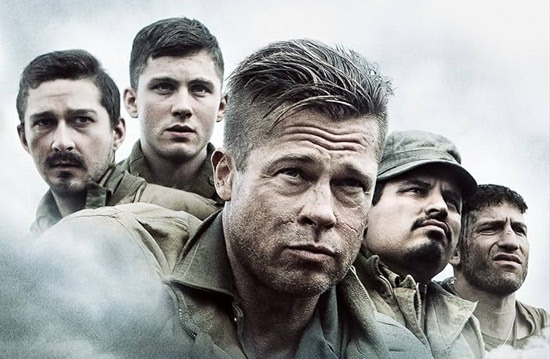
There are many war films, but one thought stays with you after watching Fury.
This film strongly conveys how humans endure in extreme situations where battles are repeated.
Rather than the scenes of bullets flying and tanks being destroyed, the state of the 20-30 year old American soldiers inside feels more realistic.
The battlefield is the most intense stress environment a human can experience.
The tension of not knowing when you might die, the inability to sleep properly, the ongoing battles, and witnessing a comrade die right next to you. The soldiers in Fury are already close to their mental limits. They appear rough and cynical on the outside, but that's just a way to cope.
There is one particularly impressive scene in this film.
As they briefly stay in a German village, a 'normal-like time' emerges that is completely different from war. Warm food, music, and a quiet space with women. The atmosphere lingers in a strangely extended way for a war film.
At first, it might feel a bit out of place. However, this scene best illustrates the human psychology in war.
Common themes arise in war records or memoirs. In extreme situations, soldiers' sexual desires and longing for intimacy become stronger than usual. This isn't just a heightened instinct; it's because the closer death is, the more the psychology of affirming life kicks in.
Psychology explains this as the 'life drive.' In situations where you don't know when you might die, the human brain seeks a stronger sense of "I am alive." Thus, elements like warm food, music, physical contact, and human conversation feel much more significant than usual.
The emotional changes shown by the rookie Norman during that brief time also align with this context.
A person who was frozen in battle changes their expression as they enter a somewhat normal environment. That scene is closer to survival instinct than romance. It's a moment where a human takes a brief breath to endure.
This phenomenon is also related to hormonal responses. In extreme tension, adrenaline and stress hormones are continuously released. The body seeks strong compensatory stimuli to relieve this tension. The increase in sexual desire is a kind of tension relief mechanism.
Another important factor is loneliness. On the battlefield, there are no families, and there is no certainty about the future. Humans inherently feel secure in relationships. Therefore, physical and emotional contact becomes a signal that says, "I am not alone."
The soldiers in Fury clinging to each other is for the same reason. They are comrades and simultaneously the last family.
This behavior is not exclusive to war. It appears similarly in people in extreme environments.
Occupations like maritime workers isolated for months or researchers at Antarctic bases also show strong relationship needs and tendencies to seek compensation.
Emergency room medical staff or rescue teams, who see the boundary between life and death daily, experience the same. When strong tension is repeated, they seek stronger rest and emotional connections outside of work.
Interestingly, similar patterns appear in high-risk financial traders.
While there is no life risk, working under extreme tension and stress leads them to seek strong stimuli and rewards outside of work. The human brain operates similarly, just in different situations.
Ultimately, what Fury shows is not just the brutality of war. It reveals that even within it, humans strive to remain human.
The closer death gets, the more people cling to life.
Even in battle, they listen to music, eat warm food, and try to hold someone's hand.
Perhaps the true message of Fury is that in extreme situations, humans do not break down; rather, they strive to become more human.







 Day by day |
 Kitchen Ideas |
 Iowa Egen Aunt |
 Beauty, Health, Lifestyle Blog |
 Always Atlanta |
 Bacon King Blog |
 Bald Eagle Brothers |
 Seattle - Emerald City |
 PETRO Vatican Shrine |
 Real Estate Agent USA |
  Finding Superfoods |
  lightyear |
  song bang |
  vexomo |
  Indiana Jones |
  meloncat |
  novapixel |
  mortrix |
  Esther 1983 |
  fortbliss |
  Moscow Kim |
  My Two Way |
  toastyfox |
  FLORIDA Acus |
  tracker |
  TONTON COFFEE |
  sunrise |
  ultron78 |
  uplifted |
  Folding Instructions |