


A family I consulted with recently has been debating for six months whether to rent a three-bedroom house in Fort Myers or to buy one.
The rent is $2,100 a month, but they learned that similar properties are priced at $395,000, and after doing the math, the answer became quite clear.
If we calculate the Price-to-Rent Ratio, dividing 395,000 by 2,100 multiplied by 12, which is 25,200, we get about 15.7. A ratio of 15 or lower favors buying, while 21 or higher favors renting, so 15.7 is in a neutral zone closer to buying. To conclude, Fort Myers is not yet a market where buying is completely unfavorable.
However, when calculating actual monthly expenses, the story changes a bit. If you buy a $395,000 house with a 20% down payment, which is $79,000, and take out a loan for the remaining $316,000 at a fixed rate of 6.75% for 30 years, the principal and interest alone would be about $2,050 a month. Adding Florida's high property taxes and hurricane insurance, the total monthly payment could rise to around $2,530. Compared to the rent of $2,100, that's about $430 more each month.
It's important to note that Florida has much higher insurance rates than the national average. Due to the hurricane risk in the Gulf Coast region, insurance premiums are on the rise every year, which contributes to the actual costs of buying being higher than renting. This is clear. In the last year or two, the increase in insurance rates in Fort Myers has created hidden costs that are not visible through the Price-to-Rent calculations alone.
From an opportunity cost perspective, it's hard to ignore the potential returns of investing that $79,000. Assuming an investment return of around 7% per year, the option to keep the down payment invested is quite attractive.
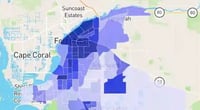
Compared to nearby Cape Coral or Naples, Fort Myers still maintains a mid-range price level. Naples has a much higher median home price than Fort Myers, while Cape Coral has similar prices but is known to have a higher insurance risk.
For Korean households, if you have a clear plan to stay for more than three years and can handle the risk of rising insurance premiums, it may be worth considering buying. Conversely, if your length of stay is uncertain or if you don't have much flexibility in cash flow, I recommend continuing to rent and keeping an eye on the stability of the market and insurance rates.
 WebVideoPro
 BerryRocket





 |
| 
 Premium Gas Camp |
 CA Real Estate |
 cheesepup |
 breezem |
 Vision XT |
 Way to easy |
 Joyce 77 |
 Blog Korea |
 Pirate Ship Popcorn Maker |
  USA Business News |
  Samsung My My |
  bubblo |
  tartbear |
  Washington Monument |
  Forever Young |
  crystalx |
  Spaghetti Flying Religion |
  lunarpath |
  Another Eden Channel BLOG |
  sprinkletop |
  bongo |
  savannah choi |
  Successful Manager Kim's Team |
  crystalo |
  Canvas Pro Blog |
  Time Management Enthusiast |
  Cap Com |
  nixxon |