

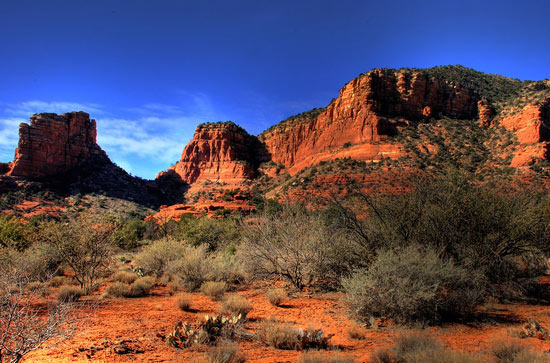
The road from Phoenix to Sedona is about 120 miles and takes 2 hours to drive.
The urban atmosphere of Phoenix gradually fades away, replaced by the dry desert and low, fan-shaped cacti.
As you head north, the scenery slowly changes, with the earth turning a reddish hue and the hills appearing larger and more solid. Driving along the I-17 highway, the view suddenly opens up, revealing distant red rock ridges. Typically, first-time visitors are amazed by the surrounding landscape from that moment on.
Another interesting point is that as the elevation increases, you feel a slight drop in temperature. The intense heat of Phoenix gradually recedes, the air becomes a bit fresher, and the atmosphere inside the car shifts to one of excitement as the red terrain comes closer.
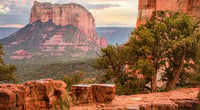
As you approach Oak Creek, the red rock mountains unfold before you like a fortress, and the realization that you have finally arrived in Sedona naturally flows out.
When you first arrive in Sedona, you may find yourself speechless. The moment the red rocks surrounding the city appear before you, your mouth drops open, and you momentarily forget to take out your camera. However, these red earth and stone mountains are not just a pretty sight; they are a geological record that holds the ancient history of the Earth.
The reason Sedona appears red, the unique layered formations, and the sculpted shapes resembling massive sculptures are all results of millions of years of natural sculpting by wind, water, and sunlight. The scenery before you feels like a museum created directly by the Earth, rather than just a tourist destination.
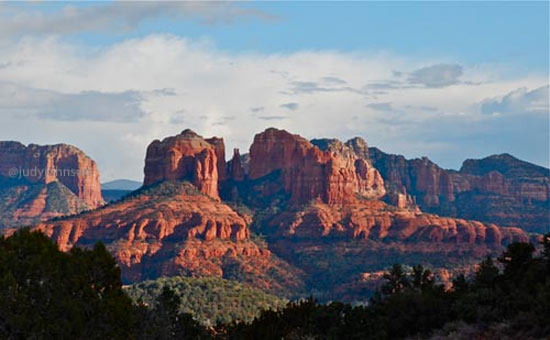
The key element that creates Sedona's red color is iron. The iron oxide contained in the grains of sandstone that make up Sedona has oxidized over time when exposed to air, ultimately transforming into the red rock we see today. In simple terms, it can be said that a massive chunk of sandstone has a 'rusty color' that has developed over tens of millions of years.
This red hue varies in intensity and atmosphere depending on the angle of sunlight; in the morning, it appears soft and reddish, during the day it is a vibrant red, and at sunset, it takes on a golden-red glow. Therefore, it never gets boring to look at throughout the day, feeling like a natural artwork with different expressions at each hour.
The shapes of Sedona's rocks are also very interesting. Most of them are formed from sedimentary layers created by ancient rivers, seas, and deserts that have solidified. These sedimentary layers have been eroded by wind and rain, transforming into various forms such as rugged cliffs, towering rocks, and flat-topped walls.
Today, famous formations like Bell Rock, Cathedral Rock, and Coffeepot Rock can be considered works of art sculpted slowly over time by nature's chisel, not human hands. Imagining it, the landscape we see now is the result of the Earth's quiet touch working for hundreds of millions of years.
Sedona also holds traces of the sea. Although it appears as a desert and rocky mountains now, there was once a shallow sea and rivers flowing through this area, and at times, sand dunes were present. The shell fossils and sand patterns found within the Sedona sandstone layers serve as evidence that this place was once underwater. It seems that many areas of the United States, including Texas, were once beneath the sea.
It is hard to imagine the current dry landscape, but after the sea and rivers disappeared, the remaining sediments solidified, and the land rose, only to be reshaped by wind and rain into its current form. The fact that ancient wave patterns are etched into the red rocks shows that Sedona is not just a desert but a 'land layered with traces of time.'
Thus, Sedona is a place where wind, water, and sunlight sculpt the Earth itself, and iron gives color to that artwork.
As you gaze at the rocks here, a sense of awe arises, wondering "How long did it take to endure and create this form?"




 US Embassy |
 fortbliss |
 Folding Instructions |
 yentra |
 Cali M Law Group |
 Kitchen Ideas |
 Toaster Pizza Magic Show |


 The Long Shot |
  Atlanta Mama |
  Baguette Blog |
  Korean Mom |
  My NYC |
  moo moo |
  Mr Oh |
  forevergee |
  festival |
  manchester |
  constant |
  Leapfrog Move |
  vibranto |
  Tora Tora |
  yellowbutter |
  Dolly |
  NYC saladbar |
  Finding Superfoods |
  lightyear |
  song bang |