
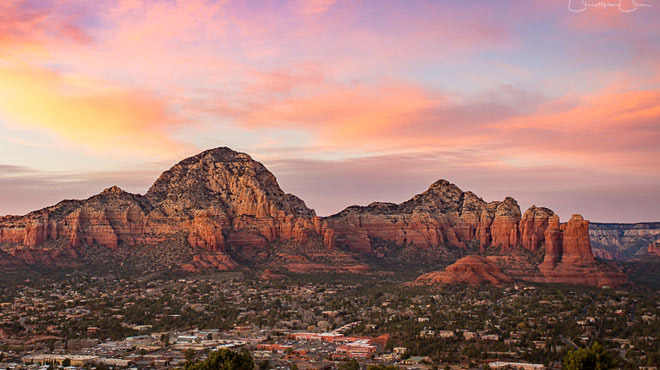
Traveling in Sedona, one might wonder who the original inhabitants were.
People who revered the red rock mountains and interpreted the sounds of the wind and the energy of nature.
While they are often referred to as "Indians," this term encompasses a wide variety of cultures. The tribes that lived around the Sedona area were influenced significantly by the Yuma people, who were widespread in Arizona, as well as the Havasupai, Apache, and particularly the Navajo and Hopi cultures in the northern regions. Sedona was more of a sacred space where multiple tribes would move seasonally, rather than the territory of a single tribe.
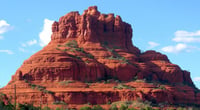
Places like Bell Rock and Cathedral Rock, which are popular tourist destinations, were not just simple rocks to the Native Americans but sacred sites for communicating with nature spirits. They believed that the shapes of the rocks were connected to celestial structures and performed rituals in accordance with the movements of the sun and moon and the changes of the seasons.
The diverse belief systems of the people who once lived in this area were intertwined with Sedona's rocky landscape. Thus, the mystical appearance of the red rocks is not merely a matter of scenery but rather the result of layers of beliefs and stories that have accumulated over time.
As Sedona became known as a tourist destination, the Native American beliefs began to be reinterpreted through the commercial term 'Vortex.'
A vortex is a concept that suggests the concentration of Earth's energy creates a strong influence, and it is said to be a place where one can experience meditation, healing, or spiritual awakening. The idea that there are vortex sites throughout Sedona spread, and travel agencies and various publications promoted this, greatly enhancing the mystical image.
So, is the vortex scientifically proven? To put it simply, no.
There is currently no scientific evidence that supports the existence of vortexes or their connection to the Earth's magnetic field or energy flows. Although physicists and geologists have conducted experiments with measuring equipment, no unusual magnetic field changes or energy concentration phenomena have been discovered.
There have been claims of electromagnetic properties created by rock formations, but they did not show significant values when compared to typical terrains.
So what is the "special energy" that people feel? Many experts explain this as an interaction between the natural environment and human psychology. The landscapes of Sedona offer overwhelming colors and scale, refreshing air from high altitudes, a sudden opening of the view, and a quietness with almost no urban noise.
When these elements combine, stress decreases, breathing deepens, and a sense of psychological stability emerges. Ultimately, as the meditative feeling and sense of freedom intensify, people express that they "feel energy."
Perhaps this is why Sedona remains even more mysterious, becoming a place that is increasingly difficult to explain the more one tries to explain it.





 Kitchen Ideas |
 Toaster Pizza Magic Show |
 The Long Shot |

 Arizona AZ Cowboy |
  citrus pop |
  Onion Ring |
  phoenixia |
  viewtop |
  loverun |
  Kim Do Sun |
  SEVEN SEVEN |
  yentra |
  Make My Day |
  Victory 1988 |
  Tonky |
  viroma |
  cookie |
  Live and that's it |
  Alright Twain |
  eatontown blog |
  HAWAII Korean Church News |
  Amore |
  linex |
  Balancework |