

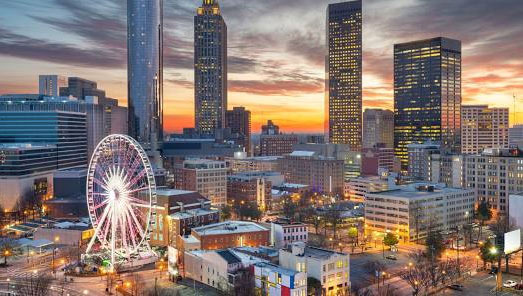
Atlanta is the capital of Georgia, USA, and an important economic and cultural center in the southern region.
Atlanta has played a significant role in American history, particularly with important events related to the civil rights movement, the Civil War, and industrialization.
- Railroad hub: Atlanta played an important role as a railroad hub, which allowed for commercial development.
- The name Atlanta is derived from geographical features related to the railroad, originally meaning "Atlantic," but due to pronunciation differences, it became Atlanta.
During the Civil War (1861-1865), Atlanta was a significant battleground, with fierce fighting between the Union and Confederate forces. In 1864, Union General William Tecumseh Sherman led the Union army to burn and destroy the city of Atlanta.
- The Battle of Atlanta: In July 1864, during the Battle of Atlanta, the Union forces defeated the Confederate army and subsequently occupied Atlanta, burning and destroying the city.
- Reconstruction: Atlanta was quickly rebuilt after the war, particularly through industrialization and the expansion of transportation networks.
In the late 19th and early 20th centuries, Atlanta rapidly industrialized and thrived as a center for railroads and the textile industry. In 1895, it held its first large-scale exhibition centered around Freedom Park, leading to economic development.
- Railroads and transportation: Atlanta achieved commercial prosperity as a transportation and logistics hub, which contributed to its economic growth.
- Industrialization: Various industries, including textiles and food manufacturing, flourished, establishing Atlanta as the center of the southern economy.
In the mid-20th century, Atlanta became one of the centers of the civil rights movement. Martin Luther King Jr. was born and raised in Atlanta, and his activities highlighted the civil rights movement in the city.
- Martin Luther King Jr.: Martin Luther King was from Atlanta and played a significant role in the civil rights movement. Atlanta has his memorial and church, preserving the historical significance of the civil rights movement.
- The civil rights movement in Atlanta: In the 1960s, Atlanta transformed into a peaceful city in the South, with several events related to the civil rights movement occurring.
Atlanta has developed into an economically, culturally, and politically significant city from the late 20th century to the early 21st century. Notably, its advancements in the Olympics and the IT industry stand out.
- 1996 Summer Olympics: Atlanta hosted the Summer Olympics in 1996, enhancing its status as an international city. The Olympics led to infrastructure expansion and economic growth.
- IT industry: In recent years, Atlanta has emerged as a hub for the IT industry and startups. Global companies like Coca-Cola, UPS, and Delta Airlines have their headquarters here, making it an economically important city.
Atlanta is a city with diverse cultural attractions, including music, film, theater, and food. It has played a significant role in music genres such as hip-hop and R&B and is also important in the film industry.
- Music hub: Atlanta is a center for hip-hop and R&B culture, with famous artists like OutKast and Migos originating from here.
- Film industry: Atlanta has rapidly emerged as a center for the film industry, with many Hollywood productions taking place in the city.
Atlanta is a city that has played a significant role in history, industrialization, the civil rights movement, and culture. Rising from the scars of the Civil War, this city has transformed into a modern metropolis where various races and cultures coexist. Since the 1996 Olympics, Atlanta has grown into an international city and is actively developing as a center for the IT industry and culture.





 moo moo |
 ultron78 |
 garlic bread |
 Sugar Cream Door Bulletproof Noodles |
 urbanmint |
 Cherokee Rose |
 Dingho and USA News |
 Korea Tiger News |
 moonshine 7 |
 DREAM BIG |
  frostbite |
  330 Forever My Love |
  El Dorado |
  dralix58 |
  Gorama Round |
  Skydiving |
  dreamport |
  Yellow Snowman |
  Toaster Pizza Magic Show |
  velvetnom |
  Anytime Journey |
  Mrs. Duluth |
  jaxter |
  Atlanta Mama |
  Baguette Blog |
  Tan Sol |
  US Embassy |
  Korean Mom |
  My NYC |