

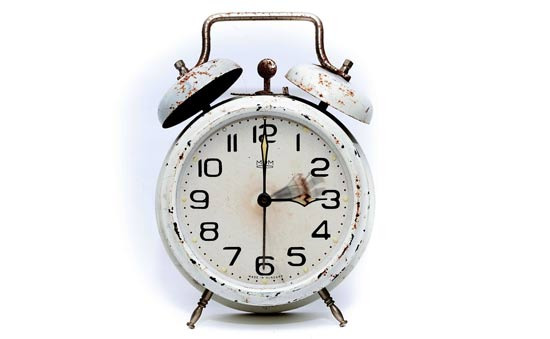
These days, it's hard to believe that children struggle to read the time on regular analog clocks.
For me, clocks were a given, and back in my day, learning to read analog clocks was a basic skill taught in elementary school. However, after talking to kids around me and seeing news reports, it seems to be true. Especially in front of an analog clock with no number dial, children reportedly hesitate for a long time when trying to tell the time.
I thought long and hard about the reasons. In fact, children today have very few opportunities to encounter analog clocks in their environment.
Smartphones, tablets, computers, and even household appliances like microwaves and gas stoves all display time in digital numbers. With just a press of a button, it shows "10:45 AM" clearly, leaving no need for interpretation. Naturally, this leads to a decline in the ability to read analog clocks.
When I was young, the large clock hanging on the living room wall was the standard for the whole family's time.
When my father asked, "What time is it now?" it was natural to look up at the clock and answer. At school, I also looked at the wall clock to know break times and lunch hours. There were even exam questions that included a picture of an analog clock, asking students to match the time. But nowadays, children habitually stare at their smartphone screens. When asked for the time, they turn on their phones to check. It's faster and more accurate.
However, I sometimes feel a sense of loss. I feel that analog clocks contain something beyond just a simple time display. The way the hour, minute, and second hands move slowly fills the day, making me realize that time is not just a simple number but a flow.
In the angles and intervals created by the short and long hands slightly misaligning, I could naturally sense "where in the day are we now." While digital clocks show a disjointed number between one minute before and one minute after, analog clocks display a continuous flow. It's a bit sad that children cannot experience this difference.
Of course, the world is changing. In an era where digital replaces everything, not being able to read analog clocks may not be a big problem. However, small inconveniences in daily life may arise. For example, if the wall clock in an old building's conference room or at a train station or airport is analog, it could be problematic if children cannot tell the time.
Moreover, they will miss out on learning the 'sense of time' that comes from clocks. The experience of learning to wait by feeling the speed at which the hands move and visually familiarizing themselves with intervals of 5 or 10 minutes is hard to gain from digital numbers.
I know a middle school student who struggles with time management during exams. When I asked why, he said that being used to digital clocks means he understands "there are 15 minutes left," but he cannot grasp "where the clock hands should be." He said he gets confused every time he looks up at the wall clock while working on the exam and ends up losing track of time. It may seem like a small difference, but it makes a clear difference in real life.
Hearing such stories makes me think that the world is changing too quickly. Children adapt to the digital world, but at the same time, they seem to be missing out on the basics that previous generations learned as a matter of course. Of course, educational settings still teach how to read analog clocks. However, since children do not encounter clocks enough to feel them, they quickly forget what they learn.
That's why I intentionally hung an analog wall clock in my living room. Whenever the kids ask for the time, I say, "Look at it yourself and tell me."
At first, they stumbled and got confused, but they gradually became accustomed to it. They are developing a sense of time by seeing that the hands are passing 12 and thinking, "It's almost lunchtime." Of course, the kids still look at their smartphones more often, but at least they have learned to read the time on an analog clock.
Time flows equally for everyone. But the way it is perceived changes from generation to generation. I still find comfort in the ticking sound of a wall clock. Children check the time by looking at the shining numbers on their smartphones.
Though different, we are ultimately living the same day.







 Magic Cabbage School of Martial Arts |
 Vacation on Hawaii |
 morvex37 |
 Ari Songhan American Immigration Life |
 Bearded Strawberry Smoothie |
 Cherokee Rose |
 Dingho and USA News |
 Korea Tiger News |
 moonshine 7 |
 laro90 |
  MEDBIO American Doctor Blog |
  SWAT TEAM BLK |
  DREAM BIG |
  frostbite |
  330 Forever My Love |
  El Dorado |
  dralix58 |
  Gorama Round |
  Skydiving |
  dreamport |
  Yellow Snowman |
  Toaster Pizza Magic Show |
  velvetnom |
  Anytime Journey |
  Mrs. Duluth |
  jaxter |
  Atlanta Mama |
  Baguette Blog |
  Tan Sol |