
In the year 2000, the boundaries of LOS ANGELES Koreatown (Koreatown)
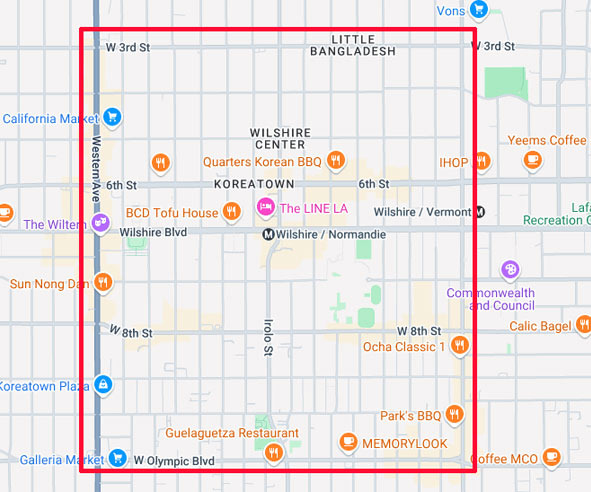
The boundaries of Koreatown were recognized as 3rd Street to the north, Western to the west, Olympic Boulevard to the south, and Vermont Avenue to the east.
In the year 2025, the boundaries of LOS ANGELES Koreatown (based on Google Maps)
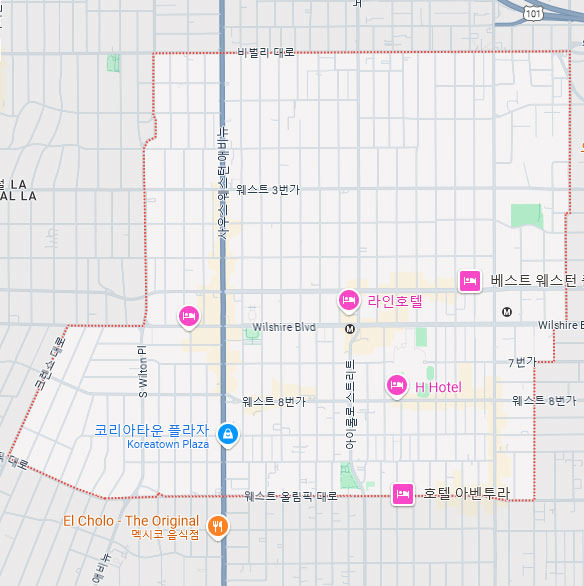
As of 2025, Los Angeles Koreatown is the most famous area of Korean concentration in the United States, home to many Koreans and Korean international students.
Locally, it is referred to as "Koreatown" or "한인 타운" (K-town), and is sometimes known by the expression "한타" (Hanta).
Los Angeles Koreatown is also the most recognized Koreatown among Koreans, as it is featured annually in Korean news media through Korean Festival news.
The formation of Koreatown is estimated to have begun in the 1960s, as many second-generation Korean Americans began to settle in the area, gradually forming a Korean village. After the 1970s, Koreans began to reside more along Olympic and Western, leading to its current development.
This area is often referred to as 'Korea within America' or 'Seoul's Nakseongdae District' due to its rich Korean elements. As of May 2024, approximately 250,000 Koreans reside in LA County, with 120,000 in nearby Orange County, and a total of 570,000 (including mixed-race individuals) in California.
It is estimated that about 130,000 Koreans live in the LA Koreatown area (including those with U.S. citizenship).
Due to the ambiguous boundaries of the Greater Los Angeles area, the number of Koreans associated with Koreatown is often viewed as being between 350,000 and 400,000.
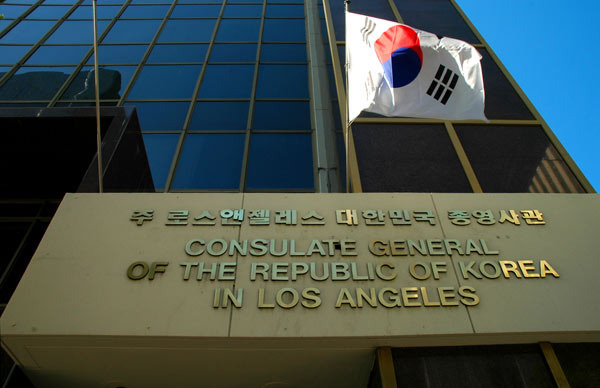
The Consulate General of the Republic of Korea in Los Angeles is also located on Wilshire Blvd, the center of Koreatown.
Los Angeles Koreatown can truly be described as 'America within Korea'.
This area is filled with many facilities commonly found in Korea, such as Korean restaurants, supermarkets, Korean businesses and banks, hospitals, academies, and traditional medicine clinics. There are various channels to experience Korean culture, including Korean radio broadcasts and newspapers. Most LA Korean restaurants cater to Korean tastes. Dishes like sundubu, jjigae, bulgogi, and galbi boast authentic Korean flavors, but marinated meats like bulgogi or galbi are often seasoned slightly sweeter than in Korea. Korean markets make it easy to find Korean ingredients and products. Most markets in Koreatown primarily handle Korean products, and many local Americans also come here to buy Korean food.
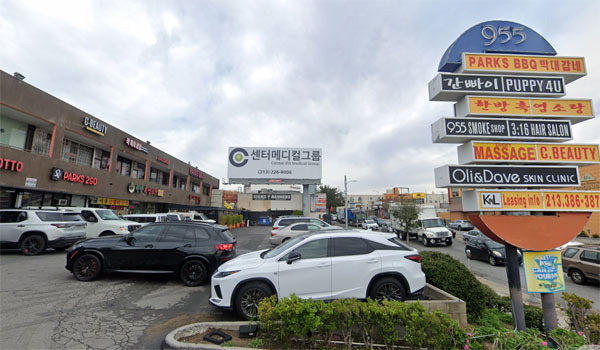
955 S. Vermont Ave, Los Angeles, 2023
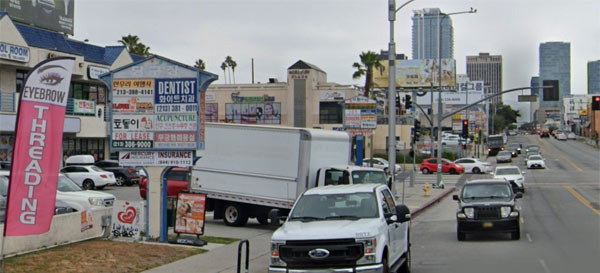
1001 Vermont Ave, Los Angeles, 2024
Los Angeles Koreatown features many shopping malls and signs that are over 30 years old, giving it a feeling as if time has stopped. The retro atmosphere created by the old design signs and shops can be a cultural shock for first-time visitors. On the other hand, this ambiance gives Koreatown its unique charm, overflowing with a distinctly Korean feel.
Koreatown frequently appears in American dramas. Especially in dramas or movies set in LA, Koreatown is depicted as an important center of the Korean community, with episodes often featuring protagonists visiting or residing in Koreatown. Recently, areas like Anaheim and Irvine on the outskirts of LA have also seen a significant formation of Korean communities, expanding the presence of affluent new towns alongside Koreatown.
As Koreatown has developed, the income levels of second and third-generation Koreans have gradually increased, and due to a strong emphasis on education, the economic level of the area has steadily improved. Areas like Anaheim and Irvine in Orange County have particularly formed well-maintained Koreatowns in recent years, creating environments similar to Korean commercial districts. Thus, these areas are also popular among students studying in LA.
Los Angeles Koreatown is rapidly developing due to the city's support. Recently, with the establishment of Millennium condos, high-rise buildings, and public facilities, the infrastructure of Koreatown has expanded rapidly. This area is modernizing with the introduction of new condos and public schools, moving away from its traditional feel to become a modern city.
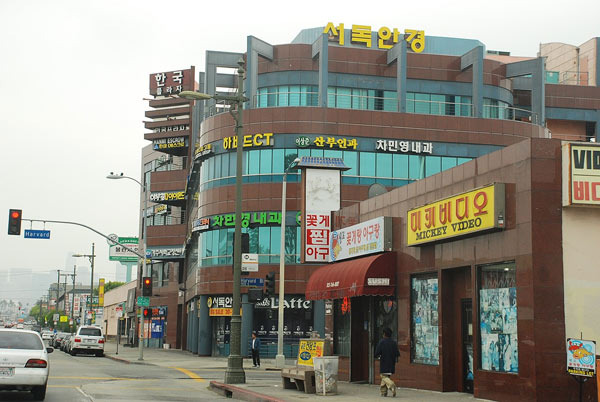
Olympic Blvd at Harvard, Los Angeles, 2007
Los Angeles Koreatown is a special area where one can truly feel Korean culture. With active Korean restaurants, supermarkets, businesses, and cultural events, it is not only the center of the Korean community but also a popular attraction for local Americans. The changes in Koreatown have established it as a rapidly developing area, continuing to evolve as a cultural center representing LA.
Issues in Los Angeles Koreatown
While Los Angeles Koreatown (Koreatown) has many advantages, it also faces several issues as a livable city.
The three most prominent issues are high rent costs, parking problems, and overcrowded infrastructure.
High Rent Costs
Rent costs in Los Angeles Koreatown have risen sharply in recent years. While Koreatown offers the advantages of being a central location with various cultural benefits, the demand for housing has surged accordingly. This has led to increased rent costs, making many people feel burdened by living in Koreatown.
- Monthly Rent: The average monthly rent for a 1-bedroom apartment in Koreatown is about $2,200 or more, while for a 2-bedroom, it ranges from $2,500 to $3,400 or more. This is relatively high compared to other areas in LA.
- Commercial Space: Commercial rent is also very expensive, and while many Korean restaurants and markets have established themselves in this area, securing commercial space remains a challenge.
People with relatively low incomes struggle to find housing in Koreatown, especially younger generations or international students who often move to the outskirts due to high rent.
Parking Problems
Koreatown is a densely populated area with a shortage of parking spaces, making it congested. Parking is particularly difficult in commercial districts or areas with many restaurants. There are often insufficient parking spaces within housing complexes, and street parking is frequently full.
- Lack of Public Parking: The number of parking lots is insufficient, leading to long wait times for parking. The parking fees near commercial areas and valet parking costs can also be high, adding to the economic burden in this high-cost environment.
- Lack of Convenient Public Transportation: While many people use the Metro and buses, many experience inconvenience due to the public transportation network not being fully developed.
Overcrowded Infrastructure and Homelessness Issues
Koreatown is a highly populated area, leading to overcrowded infrastructure issues. Traffic frequently occurs due to the dense new apartments and facilities, causing discomfort for residents and visitors. Since 2010, the issue of homeless encampments has surged, with many homeless individuals residing on public roads from MacArthur Park to Wilshire, leading to hygiene and crime problems.
- Educational Facilities: There is a shortage of schools and kindergartens in Koreatown, forcing families with children to seek educational facilities nearby.
- Medical Facilities: Hospitals and clinics are also relatively scarce compared to demand, leading to long wait times.
- Commercial Space Overcrowding: The commercial areas in Koreatown are already saturated, making it difficult for new businesses to secure space.
- Homelessness Issues: As of 2024, the number of homeless individuals in LA County is 75,518, with 46,260 in the city of LA. Public health issues, drug problems, and the response of police and emergency responders require significant human and material resources.
Los Angeles Koreatown is culturally rich and offers various amenities, but it needs to address issues such as high rent costs, parking problems, and overcrowded infrastructure and homelessness to improve the livability of the area. These problems could hinder the growth of Koreatown and pose chronic challenges to the quality of life for those living or conducting business in the area.
California has over 550,000 Korean Americans, making it the state with the second-largest Korean American population in the United States
In California, the top counties for Korean population are:
Los Angeles: 231,147
Orange: 108,693
Santa Clara: 36,584
San Diego: 31,300
Alameda: 24,765
San Bernardino: 16,328
San Francisco: 15,571
Riverside: 15,526
Contra Costa: 13,373
San Mateo: 10,199
In the United States, Korean Americans are the fifth-largest Asian American ethnic group.






 Weekend Movie Blog |
 Beauty, Health, Lifestyle Blog |
 coloradoman |
 Superman Cat Blog |
 Awesome Blog |
  manchester |
  constant |
  Leapfrog Move |
  vibranto |
  Tora Tora |
  yellowbutter |
  Dolly |
  US Embassy |
  NYC saladbar |
  Finding Superfoods |
  lightyear |
  song bang |
  vexomo |
  Indiana Jones |
  meloncat |
  novapixel |
  mortrix |
  Esther 1983 |
  fortbliss |
  Moscow Kim |