
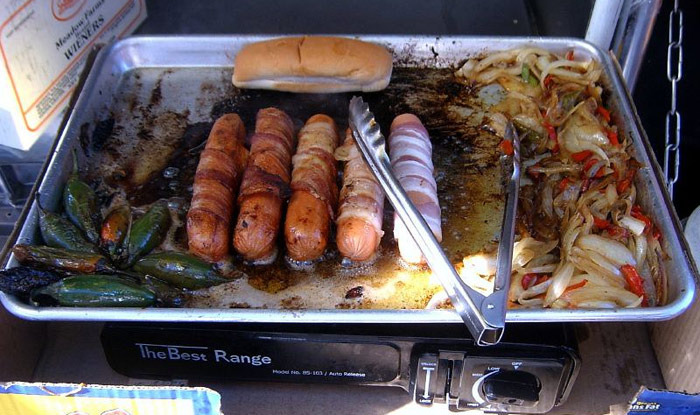
When passing by Vermont Avenue 3 or MacArthur Park, you often see Mexican food stalls lined up along the roadside.
On the griddle under the white tents, hot dogs and taco tortillas sizzle away.
Mexican music plays, and customers line up waiting for their food. The prices are cheap, and the smell is so delicious that you might think, "Is it okay to eat this?"
The problem is that not all of these street foods are operated with official permits.
Los Angeles has a long-standing tradition of street food culture.
Even now, these vendors are called "street vendors" and are spread throughout Los Angeles.
In particular, areas near Vermont Avenue 3, Pico, Wilshire, and MacArthur Park have a dense Mexican community, so almost every block has a stall during the evening. There is a variety of food such as tacos, elote (grilled corn), quesadillas, dorilocos, and burritos.
However, many of these stalls are still in an 'unlicensed' state. The city of LA introduced a legal street vendor permit system in 2018, but only a tiny fraction of vendors have actually received permits. The reason is that to obtain a permit, they must pass the hygiene standards set by the LA County Health Department, which are quite strict.
They must meet various conditions such as having sinks for food preparation, refrigeration facilities, handwashing stations, and maintaining storage temperatures, and they also have to pay monthly fees. However, many vendors are low-income immigrants who find it difficult to meet these requirements and struggle with English paperwork, often continuing to operate informally.
As a result, many street vendors around MacArthur Park or Vermont Avenue 3 exist in a 'semi-legal, semi-official' state. When the police come to enforce regulations, they sometimes quickly fold up their tents and move, while in areas where enforcement is lax, they operate almost permanently.
The city is aware of this reality, and in recent years, the approach has shifted from strict enforcement to "public health-centered management." In other words, the policy is moving towards guiding safety and hygiene rather than just enforcing regulations.
So, the answer to the question "Is it safe to eat?" is honestly 'it depends on the situation.' Some stalls are actually operating with temporary permits from the health department and maintain a clean hygiene standard. If they keep meat at the right temperature, wear disposable gloves, and cook food on the spot, they are relatively safe.
On the other hand, places that keep meat for a long time without refrigeration or cook without handwashing facilities may have hygiene issues. Especially in summer, the risk of food poisoning increases, so caution is necessary.
Famous taco stalls around MacArthur Park or elote vendors on Vermont Avenue that have been in business for a long time have gained trust from local residents. Also, since most vendors eat what they sell, it is rare for them to use very poor-quality ingredients. However, since hygiene standards do not reach restaurant levels, it is advisable for those with sensitive stomachs or weak immune systems to avoid them.
If you really want to buy and eat, it's best to choose places with many customers where cooking is done on the spot.




 Weekend Movie Blog |
 Beauty, Health, Lifestyle Blog |
 coloradoman |
 Superman Cat Blog |
 novapixel |
  Atlanta Mama |
  Baguette Blog |
  US Embassy |
  Korean Mom |
  My NYC |
  moo moo |
  Mr Oh |
  forevergee |
  festival |
  manchester |
  constant |
  Leapfrog Move |
  vibranto |
  Tora Tora |
  yellowbutter |
  Dolly |
  NYC saladbar |
  Finding Superfoods |
  lightyear |
  song bang |