
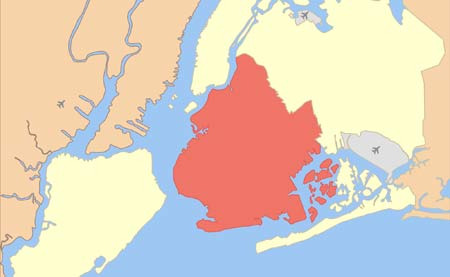
In New York City, the Korean population has traditionally concentrated in areas like Flushing, Queens, and Bergen County, New Jersey, but in recent years, the number of Koreans living in Brooklyn has gradually increased. Young Korean professionals, artists, and students are increasingly moving to Brooklyn in search of more spacious living conditions, avoiding the high housing prices and cost of living in Manhattan. Let's take a closer look at what makes Brooklyn attractive to Koreans.
One of the most important reasons is the accessibility to Manhattan. Brooklyn serves as a terminal or transit point for many New York subway lines, allowing travel to Midtown Manhattan in 20 to 35 minutes and to Lower Manhattan in 10 to 20 minutes by subway. Various lines, including A, C, E, F, G, J, L, M, N, Q, R, 2, 3, 4, and 5, cover different areas of Brooklyn. For Koreans who work or study in Manhattan but are looking for relatively affordable housing, Brooklyn is a practical alternative. The average rent is 20 to 40% lower than in Manhattan, with the average for a one-bedroom in Brooklyn around $2,800 to $3,500, while in Manhattan, it often exceeds $4,000 to $5,000.
The educational environment is also a factor that Korean families prefer. Brooklyn is home to prestigious public specialized high schools like Brooklyn Latin School and Brooklyn Technical High School, the latter being the school with the highest number of admissions among New York City specialized high schools. There are also CUNY-affiliated institutions like Brooklyn College and Medgar Evers College, as well as private universities such as Pratt Institute and LIU Brooklyn. Additionally, many excellent public elementary and middle schools are concentrated in areas like Park Slope, Carroll Gardens, and Dyker Heights, where many Koreans reside.
Cultural diversity and an open atmosphere are also significant factors. Historically, Brooklyn has been a region where Jewish, Italian, Caribbean, African, and Hispanic immigrant communities coexist, fostering a culture that is welcoming to immigrants and accustomed to diversity. This creates an environment that alleviates the psychological burden for new immigrants or migrants adapting to a foreign environment. Furthermore, with abundant parks and green spaces, residents can enjoy leisure time in various parks, including Prospect Park, Brooklyn Bridge Park, and Fort Greene Park.
In terms of Korean living infrastructure, the accessibility to nearby Flushing (Queens) and Palisades Park and Fort Lee (New Jersey) is a strong point rather than Brooklyn itself. It takes about 40 to 50 minutes by subway to get from Brooklyn to Flushing and about 1 hour to 1 hour and 20 minutes by public transport to Fort Lee. While there are gradually more Korean markets, restaurants, and salons in Brooklyn itself, the convenience of life is improving. Although many people still rely on cars or public transport to access large Korean markets like H-Mart or Han Ah Reum, the growing Korean community is increasing opportunities to find Korean ingredients closer to home.
 TigerMilkFoam
 MeadowVision





 garlic bread |
 Sugar Cream Door Bulletproof Noodles |
 urbanmint |
 |
| 
 Premium Gas Camp |
 Franco Family |
 Starbucks Reserve Roastery Closure |
 newyorker 101 |
 Softember |
 Encyclopedia of New York and Surrounding Areas |
  uplifted |
  Folding Instructions |
  same same life |
  USA Hyundai Kia |
  morvex37 |
  BOL SA RAM |
  TOUCHE NEWS |
  Small Business Information USA |
  draxen |
  gallery |
  milkyotter |
  Zoom Zoom Zoom |
  Minnesota Lakes and Clouds |
  noraro |
  tervox95 |
  vale vale |
  yentra |
  Golden life |
  andrew park |
  Peter Pan Pet |