
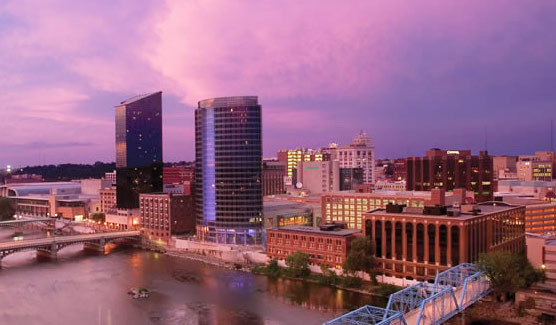
Grand Rapids is considered a city with relatively low traffic congestion among Midwestern cities in the United States.
Unlike major cities like Detroit or Chicago, where severe traffic jams are a daily occurrence, Grand Rapids has a well-maintained road network relative to its population size (about 200,000). However, a significant drawback is the inadequate public transportation system, making it difficult to live without a car.
Looking at the major highway network, Grand Rapids is located at the intersection of several key highways. I-96 connects Grand Rapids to Lansing and Detroit to the east, while linking to the Lake Michigan coastal cities to the west. I-196 runs through downtown Grand Rapids, connecting to Holland to the southwest and Kalamazoo. US-131 is a crucial road that runs north-south through the center of Grand Rapids, extending to Cadillac in the north and Kalamazoo in the south. These three highways form the backbone of Grand Rapids' transportation.
Traffic congestion during rush hours is better than in major U.S. cities, but there are unique bottlenecks in Grand Rapids. The area known as 'Spaghetti Junction,' where US-131 and I-96 intersect, experiences congestion during the morning hours of 7-9 AM and the evening hours of 4-6 PM. The approach to downtown Grand Rapids also tends to see a concentration of vehicles during rush hours. However, this is on a different level compared to the severe congestion in Chicago or Detroit, and even during rush hours, the average commute time to downtown is often around 20-30 minutes.
The public transportation system is identified as a weakness in Grand Rapids. The Rapid, which operates bus routes, is the main public transportation option, but the number of routes, frequency, and operating hours do not meet the standards of larger cities. Living in Grand Rapids using only public transportation can be quite inconvenient. The Rapid operates on major routes with intervals of 30 minutes to 1 hour, and during nights or weekends, the intervals are even longer. In some areas of downtown Grand Rapids, free electric shuttles (Silver Line, Dash service) operate to assist with movement within downtown.
Bicycle traffic infrastructure has significantly improved in recent years. The city of Grand Rapids is expanding its network of dedicated bike lanes and shared lanes, and a bike share service is also available in the downtown area. During the summer season, the number of residents commuting by bike noticeably increases. However, due to winter snowfall, the period during which biking is difficult is long, making it challenging to rely on bicycles as a primary mode of transportation year-round.
The parking environment is one of Grand Rapids' advantages. There are sufficient public parking lots and paid parking structures even in the downtown area, so the parking wars commonly experienced in major U.S. cities are not severe. Most residential areas have dedicated garages or driveways, so parking at home is not an issue.
In Grand Rapids, having a car is not optional but essential. Due to the low reliance on public transportation, not owning a personal vehicle makes everyday activities like shopping, visiting the hospital, and commuting to work very inconvenient. Uber and Lyft services are available, but wait times may be longer compared to larger cities. Car insurance rates tend to be higher than the national average due to Michigan's characteristics, so it's advisable to check insurance costs before moving.
 IronSquid
 SquidSpinKill




 My Town My Way Blog |
 Arizona AZ Cowboy |
 Valley Hong |
 Mr Oh |
 ollege Mom |
 apricotla |
 carpflow |
 oneonly |
 icotla |
 So is multiplied by So, So Ji-sub |
  Fragile Me |
  Rowland Mama |
  foxtree |
  bayaa |
  loveyom |
  Coastal city |
  Spaghetti Flying Religion |
  holy cow |
  endone |
  starline |
  Where is a really nice neighborhood? |
  Real Estate |
  Forest Gump |
  Real Estate Investment Korean American |
  Dollydori, Lover of Movies |
  dmzline |
  travelo |
  American Food Information & Calories |
  Splendid Mission |