

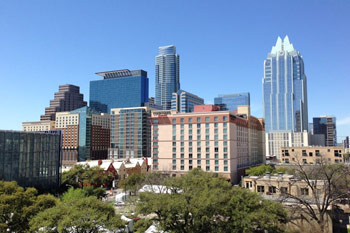
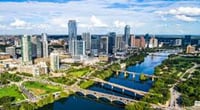
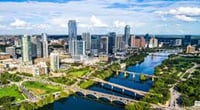
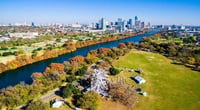
Surrounded by the Colorado River, the city is interspersed with lush greenery, allowing for a natural blend of urban and nature. Geographically, it is conveniently situated between the Dallas-Fort Worth area to the north and Houston and San Antonio to the south, making it easy to access anywhere in Texas. Summers are long and hot, while winters are short and mild, providing a distinct four-season climate that is pleasant to live in. As of 2020, the city has a population of about 1 million, and when including the metropolitan area, it exceeds 2 million.
Particularly, there is a large young population and a diverse mix of races and backgrounds, creating a vibrant atmosphere. Economically, Austin is recognized as one of the top tech hubs in the U.S. Major global companies like Dell, IBM, Oracle, AMD, and NXP have established their headquarters here, and recently, Tesla, Apple, and Google have expanded their large campuses, transforming the city into a center for the tech industry. As a result, the western part of Austin is often referred to as 'Silicon Hills.'
Additionally, the startup ecosystem is robust, attracting young entrepreneurs and investors. As the capital of Texas, Austin is home to many state government agencies, courts, and public institutions, providing ample job opportunities in administrative and public sectors. Meanwhile, tourism and culture are also significant. Major music and arts festivals like SXSW (South by Southwest) and ACL (Austin City Limits) draw people from around the world every year. This has led to a thriving hotel, restaurant, performance venue, and service industry, keeping the city buzzing with energy.
The education level is also high. The University of Texas at Austin (UT Austin) is considered a top-tier public university in the U.S., and there are also private institutions like St. Edward's University and Concordia University that maintain high standards. Moreover, not only in downtown Austin but also in suburban areas like Round Rock, Cedar Park, and Leander, the school districts are known for their excellence, attracting many families with children.
There are well-established ESL programs for students whose first language is not English, making it a good environment for international students and Korean families. However, due to its rising popularity, real estate prices in Austin have increased rapidly. Housing prices and rents are definitely higher compared to Dallas or Houston. Especially in the downtown area or the northwestern suburbs, demand is high, so careful selection based on budget and lifestyle is necessary. Transportation is honestly a weak point. Public transportation infrastructure like buses and light rail is lacking, and most people rely on cars. During rush hours, traffic congestion is severe, so considering the location of work or school when choosing a residence is a practical approach.
Nonetheless, the city is currently pushing transportation improvement projects, such as expanding light rail lines. It will take time to complete, though. Culturally, Austin is known as the "Live Music Capital of the World" due to its many performance venues, and busking is common on the streets. The artistic vibe permeates the city, not just in music but also in art, food, and fashion. You can't talk about Austin without mentioning BBQ and Tex-Mex cuisine. Barbecue houses with rich smoked meat aromas and Mexican-style restaurants are plentiful throughout the city.
There are also many recreational spaces like Lady Bird Lake and Barton Springs Pool, where you can easily see people picnicking or kayaking right in the heart of the city on weekends. In short, Austin is a city where work and leisure, nature and urban life blend perfectly. That's why many people refer to it as "one of the most desirable cities to live in the U.S."


 ultron78 |
 garlic bread |
 Sugar Cream Door Bulletproof Noodles |
 urbanmint |
 |
| 
 quanta7 |
 Living with a Consistent Heart |
 |
| 
 U.S. Weather Bureau News |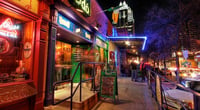
 Dallas Fort Worth DFW |
  Korean Mom |
  My NYC |
  moo moo |
  Mr Oh |
  forevergee |
  festival |
  manchester |
  constant |
  Leapfrog Move |
  vibranto |
  Tora Tora |
  yellowbutter |
  Dolly |
  US Embassy |
  NYC saladbar |
  Finding Superfoods |
  lightyear |
  song bang |
  vexomo |
  Indiana Jones |