

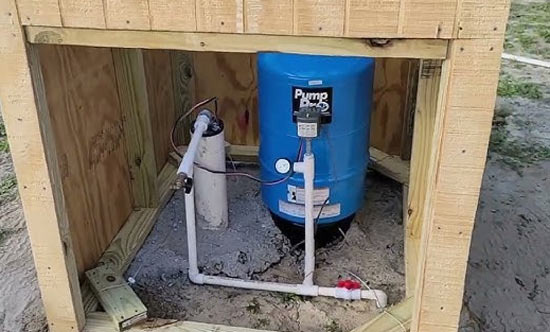
In the United States, there are quite a few areas where people live without being connected to public water and power grids, relying instead on private water and power generation.
Notable examples include Alaska and Texas. Of course, in many remote areas of each state, there are no public water lines, so using wells is standard, and electricity is often generated by generators or solar power. I've heard that many people in the West Virginia and Kentucky areas also use private water and power systems.
In Texas, where I live, the land is over seven times larger than South Korea, so it's common for ranches and private homes in rural areas to use wells and wind power together. Even in homes connected to the state power grid, many maintain independent systems to prepare for power outages or billing issues, and in West Texas, the wind is favorable, making small wind turbines quite common.
Private Wells are Common in Texas
According to EPA statistics, about 13% of the total population relies on private wells for their water supply. In Texas, that percentage is even higher. In areas like Hill Country or West Texas, there are much larger regions without city water connections. Just a 30-minute drive from Dallas or Austin into the suburbs, you can easily find homes using well water. Drilling a well typically costs between $5,000 and $15,000. In Texas, where the groundwater levels are deep, costs can be a bit higher.
However, once you have a well, your monthly water bill is $0. There are, of course, no usage limits. Whether you want to water your yard or fill a swimming pool, it's entirely up to you. The downside? Water quality testing is entirely your responsibility. The government does not do it for you. If the pump breaks, you'll have an immediate water outage. You have to call a service provider to fix it yourself.
Power Generation: The Off-Grid World
The same goes for electricity. More households are steadily adopting complete off-grid living by equipping solar panels with battery systems. Texas has some of the highest sunlight levels in the U.S., making solar efficiency very high. With the availability of home batteries like the Tesla Powerwall, the technical barriers to entry have significantly lowered. The initial installation cost ranges from $20,000 to $50,000, but with zero monthly electricity bills and federal tax credits (ITC), the long-term ROI is definitely favorable.
Complete Self-Sufficiency with a Septic System
It's not just about water and electricity. In areas without sewer connections, septic tanks are installed. In rural Texas, having a septic tank is actually the norm. The maintenance cost is minimal, as it only requires pumping every 3 to 5 years. With a private well, solar power, and a septic system, you can achieve complete independent living. This is the reality of rural Texas.
So, My Thoughts Are
The essence of this lifestyle is ultimately self-reliance.
It means controlling your life without depending on government infrastructure. Of course, there are initial costs and ongoing maintenance efforts required. Nothing in this world is free. However, remember that during the 2021 Texas power crisis (Winter Storm Uri), homes connected to the power grid shivered in the cold for days, while off-grid homes remained unaffected. It's worth seriously considering whether a life that relies 100% on the system is truly safe.







 moo moo |
 ultron78 |
 garlic bread |
 Sugar Cream Door Bulletproof Noodles |
 urbanmint |
 xylora |
 wendra |
 There Are Such Things in the World |
 Texas Migration Story |
  Cherokee Rose |
  Kor. Master |
  Holey Moley |
  Conflite Teacher |
  Hodong Prince Over Flex |
  Mist inn |
  citrus pop |
  Onion Ring |
  phoenixia |
  viewtop |
  loverun |
  Kim Do Sun |
  SEVEN SEVEN |
  yentra |
  Make My Day |
  Victory 1988 |
  Tonky |
  viroma |
  cookie |
  Live and that's it |