

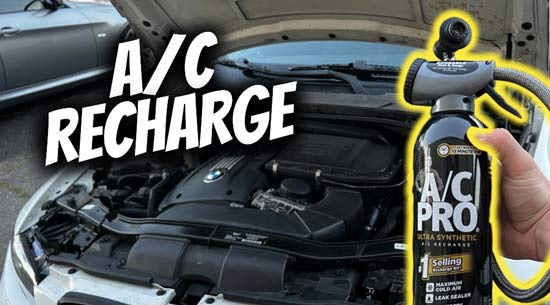
As summer approaches, stories about car air conditioners not being cool enough can be heard everywhere.
In areas like Palm Springs, where summer temperatures regularly exceed 100 degrees, a broken air conditioner can make driving nearly unbearable.
As a result, when you visit auto parts stores, you'll find refrigerant recharge kits selling for dozens of dollars, and YouTube is filled with videos titled "Recharge Your AC Refrigerant in 10 Minutes."
"A repair shop charges $200, but I can do it myself for less than $50."
But is that really the case? DIY refrigerant recharging is possible, but I personally do not recommend it.
The biggest reason is that you don't know the cause of the refrigerant shortage.
Unlike engine oil, refrigerant is not a consumable that naturally decreases over time.
In a normal system, the refrigerant should remain nearly the same for several years.
If the refrigerant is low, it likely means there is a leak somewhere.
However, many people simply top off the refrigerant.
It's like continuously pouring water into a bucket with a hole in the bottom.
You might feel cool for a while, but there's a high chance you'll be low on refrigerant again in a few weeks or months.
The second issue is overcharging.
DIY kits come with pressure gauges, but they are not as accurate as you might think. Each car has a different optimal refrigerant amount, and the pressure also varies with external temperatures.
While low refrigerant is a problem, putting in too much is also an issue.
Overfilling the refrigerant can strain the compressor and actually reduce cooling performance.
In severe cases, it could lead to a compressor replacement costing hundreds of dollars.
The third issue is vacuuming.
When a repair shop services an air conditioning system, they don't just add refrigerant.
They use a vacuum pump to remove air and moisture from the system.
This process is very important.
If moisture enters the refrigerant system, it can corrode internal components and reduce cooling performance.
While it may seem fine at first, it could be detrimental in the long run.
That said, DIY isn't always a bad option.
For example, if you're driving a 15-year-old used car worth around $3,000 and the air conditioning is just slightly less cool, it might be worth a try.
In fact, some vehicles may lose refrigerant very gradually over several years.
However, if you have a newer vehicle or plan to keep your car for a long time, the situation is different.
Getting an accurate diagnosis using refrigerant recovery and vacuum equipment at a repair shop may be more cost-effective in the long run.
In my experience, DIY refrigerant recharging should be considered a "first aid" measure.If your air conditioning suddenly blows lukewarm air and you need to go on a trip, or if you want to extend the life of an older vehicle, it can be helpful.
However, it is not a fundamental repair method.
While YouTube may make it look like a 20-minute fix, actual mechanics check why the refrigerant is low, where the leak is, and whether the compressor and condenser are functioning properly.
In the end, car air conditioning is similar to human health.
Just taking fever reducers when you have a fever doesn't cure the illness.
Finding out why the refrigerant is low is the real repair.
Therefore, I believe that getting an accurate diagnosis, even if it costs a bit more, is the wiser choice in most cases.
 ToastWizard
 BeginnerGame







 cherrydino |
 victoria 68 |
 American Man in a Mask |
 kuku 100 |
 novent |
 Star Blog |

 Sarah's Blog |
 Casa Mia |
 novapixel |
  mortrix |
  ollege Mom |
  Esther 1983 |
  Arizona AZ Cowboy |
  fortbliss |
  Moscow Kim |
  My Two Way |
  toastyfox |
  FLORIDA Acus |
  tracker |
  TONTON COFFEE |
  sunrise |
  ultron78 |
  uplifted |
  Folding Instructions |
  same same life |
  USA Hyundai Kia |
  morvex37 |
  BOL SA RAM |