

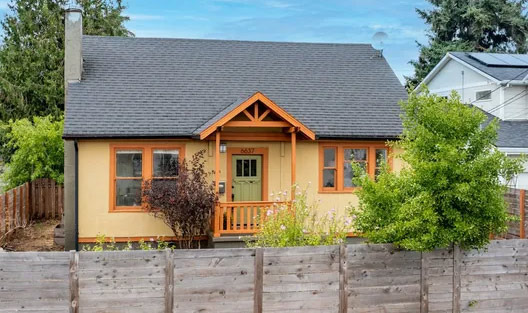
Most single-family homes start in the low $500,000s, while well-located and decent-condition homes exceed $600,000. Condos or small townhouses should be approached with a baseline of around the high $400,000s.
The reason Portland's home prices remain this way is simple. There is not much inventory, and demand is steady. Although the period of rapid increases after the pandemic has passed, there are still not many people looking to sell, and the influx of population and investment demand into Portland continues.
As a result, while prices are not rising significantly, they are also not easily falling, creating a stable market. Over the past year, the average home value has slightly increased by about 0.8 percent, but many feel that the actual prices are much higher. In competitive situations, good homes still sell quickly, and there are often bidding wars.
Comparing this situation to the entire state of Oregon makes the difference even clearer. The median home price in Oregon is about $379,000, while Portland is more than $100,000 higher than that.
The issue lies in the income structure. The median household income in Oregon is about $63,000, making the ratio of home prices to income quite burdensome. In simple terms, it means that home prices have already outpaced what can be managed with a salary. This burden is felt even more in urban areas like Portland, where demand for school districts, jobs, and infrastructure is concentrated.
A characteristic of the Portland housing market is that it is neither extremely hot nor cooling down. As interest rates fluctuate, transaction volumes rise and fall, but home prices themselves do not move much.
Sellers have no urgent reason to sell, and buyers eventually return to the market after waiting. In this structure, expecting a significant drop is difficult, and aiming for a short-term spike is also not easy. Instead, in the long term, it is closer to a stable market.
Therefore, for those looking to buy a home in Portland, strategy is important. Many approach it from the perspective of residential stability and long-term holding rather than short-term profits. There are also significant regional differences. Downtown, NW, and SW areas remain strong, while the eastern areas have relatively lower price entry barriers but have steadily increased over the past few years.
In conclusion, the current Portland housing market is expensive yet solid. It is not a boom market, but it is also not an easily collapsing one. Whether for residential purposes or long-term investment, the most realistic strategy is to keep a steady eye on market trends and approach it with local experts.







 moo moo |
 ultron78 |
 garlic bread |
 Sugar Cream Door Bulletproof Noodles |
 urbanmint |
 Sunset Oregon |
 Oreore Mushroom |
 Time Management Enthusiast |
 jammybear |
  Tonky |
  viroma |
  cookie |
  Live and that's it |
  Alright Twain |
  eatontown blog |
  HAWAII Korean Church News |
  Amore |
  linex |
  Balancework |
  laro90 |
  MEDBIO American Doctor Blog |
  SWAT TEAM BLK |
  DREAM BIG |
  frostbite |
  330 Forever My Love |
  El Dorado |
  dralix58 |
  Gorama Round |
  Skydiving |