

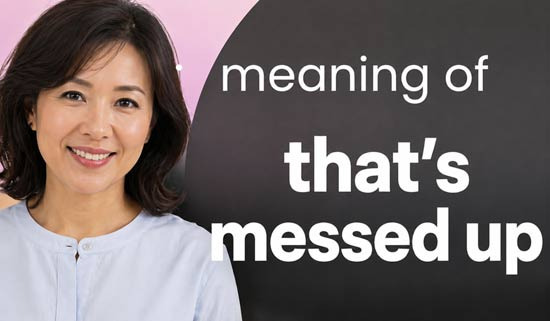
When the phrase "Hey, that's messed up." comes up in English conversation, those hearing it for the first time might feel a bit confused.
Since it says "messed up," one might think it means something is mixed up or broken.
However, when Americans use this phrase, it often conveys a sense of "Hey, that's a bit much," "That's really not okay," or "That doesn't make sense logically."
In simpler terms, it's something you say when someone crosses a line.
If you just say, "That's wrong," it means "That's incorrect," but "That's messed up" carries a bit more emotion.
In Korean, it would be similar to saying, "That's not right," "Hey, that's too much," or "You've crossed the line."
Adding "Hey" at the beginning enhances the feeling.
Simply saying "That's messed up" is a calm response, while "Hey, that's messed up" feels more like pointing out the other person's behavior.
For example, if a friend says, "My boss made me work all weekend and didn't pay me overtime,"
they are saying they were made to work all weekend without receiving overtime pay.
In this case, saying "Hey, that's messed up" expresses empathy, like saying, "Wow, that's really unfair." It creates a very natural conversation.
If someone says, "He read my private messages without asking," it means they looked at your private messages without permission.
In this situation, saying "That's messed up" fits perfectly.
It conveys the feeling of "That's an invasion of privacy. That's too much."
This expression is especially common among close friends when sharing unfair or outrageous stories.
Americans place a lot of importance on reactions during conversations; just saying, "Oh, really?" repeatedly can feel a bit bland.
Using "That's messed up" appropriately makes the response feel much more natural and relatable.
However, there's a caution here. "That's messed up" is used for situations or actions, but if you directly say, "You're messed up," it can come off much stronger.
It might sound like, "There's something wrong with you as a person." This could lead to a fight.
So, beginners should definitely use "That's messed up" to focus on the situation for safety.
Another similar phrase is "That's not fair."
This means "That's not fair," and is a bit softer.
It's often used with children and is relatively safe in the workplace.
On the other hand, "That's messed up" is more casual and emotional.
"That's wrong" is the most basic expression. While it means something is incorrect, it can sound a bit stiff in conversation.
"That's crazy" conveys a sense of disbelief, like "That's unbelievable," and doesn't necessarily imply a moral wrongdoing.
If you want to intensify it a bit, you can say, "That's really messed up," which means "That's really too much."
Conversely, if you don't want to sound too harsh, you can say, "That's kind of messed up," which softens it to mean "That's a bit off," or "That doesn't seem right."
In English, it's not just about memorizing word meanings; you also need to understand the context and emotions behind these phrases.
"Hey, that's messed up" is not textbook English; it's everyday language.
It's used when someone has faced an unfair situation, when someone has acted rudely, or when you hear about something that doesn't make logical sense.
Just think of it as something to use among friends or people you're comfortable with.
Using it in front of a boss might come off as slightly rude, so in the workplace, expressions like "That doesn't seem fair" or "That's inappropriate" are safer options.
Ultimately, the essence of this expression is the feeling of "Even I can see that's a bit much."
Grasping this nuance will make your English reactions feel much more natural.
 Amulius
 CoffeeDreamer





 Casa Mia |
 TEXAS Fishing Boat |
 Study Abroad Life Know-How Tips |
 pravix22 |
 American Hardcore Band |
 Until the Day It Gets Better |
 Sunny Fullerton |


 Agenda Center |
  chicpo |
  monorama tone |
  Good News Good Thoughts |
  Kentucky Fried Chicken |
  bloomberg |
  morninpo |
  my town K blog |
  bravik31 |
  Various Knowledge and Information in the USA |
  orvik90 |
  San Gabriel Mountains |
  quanta7 |
  Fransco Family |
  leonee |
  Augusta 90 |
  Project Tomorrow |
  DOCTOR MED |
  Say IT Now |
  Alpha and Omega World |
  Always Dreaming of Big Success |