

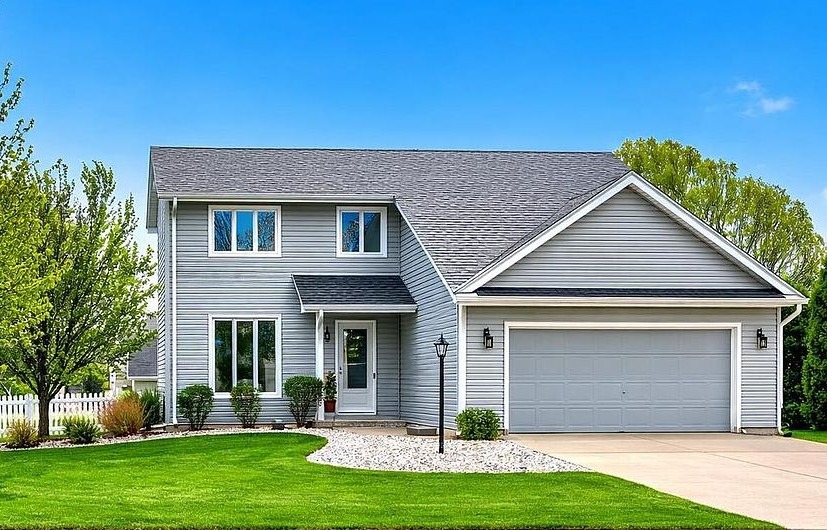
Recently, it has become a reality that 30-somethings in the U.S. are struggling to buy homes on their own. This issue is even more pronounced in major urban areas.
There are comments like, "Salaries have increased compared to the past, so why can't they buy homes?" However, looking at the real estate situation provides the answer. It's not just a matter of lacking money.
The first issue is that home prices have already outpaced income levels. In these areas, the average home price exceeds $700,000, and for good school districts or locations, it's common to see prices over $1 million. The problem is that the average income for 30-somethings cannot keep up. In the past, homes that were about four times the annual salary are now over eight times that amount.
The second issue is interest rates. In recent years, mortgage rates have risen sharply, significantly changing the financial burden. Even for homes at the same price, the monthly payment can differ by thousands of dollars. For 30-somethings, it becomes a situation where they can buy a home but cannot afford to maintain it. As a result, many choose to give up on purchasing or keep postponing it.
The third issue is the down payment. As home prices rise, the initial funds required have also increased. Based on a 20% down payment, a $1 million home requires at least $200,000. It is realistically difficult for 30-somethings to save this amount on their own, especially when they are also dealing with student loans, rent, and living expenses.
The fourth issue is the rental market. Ironically, one reason they can't buy homes is due to high rents. Because rent is so expensive, saving becomes difficult. Without savings, they cannot accumulate a down payment. This cycle continues. In places like LA or New York, the rent is already at a high level, making it hard to prepare for buying a home.
The fifth issue is job stability. Job changes are more frequent than before, and career paths have become less stable. To buy a home, long-term income stability is necessary, but 30-somethings are still in a phase where their careers are not fully established. Therefore, taking on a large loan is also a psychological burden.
The sixth issue is changing priorities in life. Nowadays, 30-somethings are less likely to think they must buy a home first, like previous generations. They also value spending on travel, experiences, and self-development. This is not just a matter of consumption; it's also a choice of not wanting to tie their lives to just one home.
Finally, an important issue is the supply problem. In these areas, there is not enough new housing being supplied. Due to regulations, land issues, construction costs, and various other reasons, supply is limited. Demand continues to rise, but with insufficient supply, prices keep increasing. This is not a problem that can be solved by individual effort.
In summary, the issues of home prices, interest rates, initial funds, rent, job structures, and supply are all interconnected. Therefore, the inability of 30-somethings to buy homes is more a societal issue than a personal capability issue.
To simply view this as "young people today can't save money" is to oversimplify the reality. In the current market, it's not just about working hard; it has become a game that requires timing and structural alignment.
The U.S. has less concern about a population cliff, and with the baby boomer generation entering an aging era, it is hard to predict how the housing crisis will be resolved in the future.
While rising home prices can help increase asset accumulation, I believe that the structure that simultaneously takes away purchasing opportunities from younger generations is not beneficial from a societal perspective.







 |
| 
 Premium Gas Camp |
 CA Real Estate |
 cheesepup |
 breezem |
 Franco Family |
 glimmer |
 newyorker 101 |
 Round and Round Children's Song Kingdom |
 coffeee |
  |
|  Christopher |
  sylven |
  Sammy Beach |
  Bliss O |
  blue ocean |
  greenlight |
  Watanaka Karametibaksa |
  castle |
  xelton52 |
  carefree |
  vrixen73 |
  AZ Road Master |
  Victory 1988 |
  summita |
  business lim |
  Colorado Lee |
  Make My Day |