

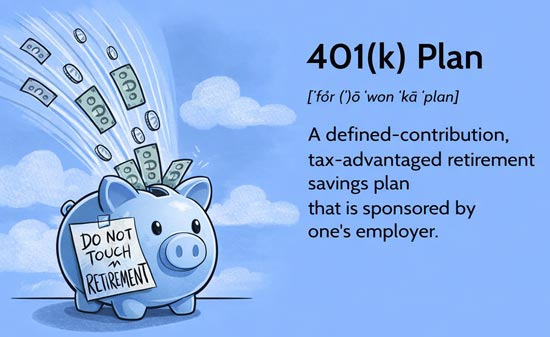
In the United States, the 401(k) seems like a standard system, but it wasn't always this way.
The 401(k) began in 1978, originally intended to allow employees to save bonuses without tax.
However, in the 1980s, companies started to actively utilize it, changing its structure.
Instead of pensions, which were the responsibility of the company, it transitioned to a 401(k) that individuals manage themselves.
In simple terms, it's a system that "transfers the responsibility of retirement from the company to the individual."
This spread quickly because it was advantageous for companies.
Pensions require companies to be responsible for employees' retirement for life, but with a 401(k), employees invest directly and take responsibility for the outcomes.
As a result, most companies now offer 401(k) plans instead of pensions.
However, there is one aspect that many people are unaware of: a 401(k) is not an account that remains unchanged for life.
After a certain age, it effectively becomes a structure where you are "forced out."
Specifically, when you turn 73, a regulation called RMD (Required Minimum Distribution) applies.
In simple terms, it means "now you need to withdraw some money and pay taxes." You can no longer defer taxes indefinitely.
From this point on, you must withdraw a certain amount each year.
Another important situation arises when you leave a company.
When you retire, change jobs, or retire, your existing 401(k) no longer needs to be tied to the company plan.
Most people choose to do a rollover at this point.
This rollover is key. Instead of leaving the 401(k) as is, you transfer it to a personal account like an IRA.
If done correctly, this greatly expands your investment options.
This is because 401(k)s have structural limitations.
You don't get to choose investment products freely; instead, you select from a "menu" set by the company and financial institutions.
Companies typically select firms like Fidelity Investments, Vanguard Group, or Charles Schwab, which create a list of funds.
This list includes U.S. stock index funds, global stock funds, bond funds, and target-date funds.
Employees only determine the proportions. They don't select individual stocks but choose from "bundled products."
The issue is that while there are options, there isn't complete freedom.
Some companies have many good low-cost index funds, while others focus on high-fee products. Thus, even with the same 401(k), the investment environment can vary significantly.
As a result, many people eventually move their 401(k) elsewhere. By rolling over to an IRA, you can directly choose ETFs, individual stocks, and various bond products. You can often lower fees as well.
There are some important tips here.
First, if you've changed jobs, it's advisable not to leave your existing 401(k) unattended and to consider a rollover.
Second, you should check the fee structure. 401(k)s often have hidden costs that are more significant than expected.
Third, you need to decide whether to keep it in a target-date fund or switch to direct management based on your investment style.
This strategy becomes even more important, especially after age 50.
With limited time until retirement, "where you place your money" directly impacts your returns.
Ultimately, the 401(k) is just the beginning.
Initially, it serves as a tool to take advantage of tax benefits, in the middle, it becomes an investment vehicle, and finally, it turns into a withdrawal strategy.
You shouldn't view it as a single entity throughout. Strategies need to change at each stage.







 You Only Live Once |
 Texas Real Estate Blog |
 zentar |
 seouljung |
 AliAluAlo Blog |
  newyorker 101 |
 Encyclopedia of New York and Surrounding Areas |
 International Court |
 PPAP Pineapple Pen |
 Living in the Eastern United States |
  coffeee |
  |
|  Christopher |
  sylven |
  Sammy Beach |
  Bliss O |
  blue ocean |
  greenlight |
  Watanaka Karametibaksa |
  castle |
  xelton52 |
  carefree |
  vrixen73 |
  AZ Road Master |
  Victory 1988 |
  summita |
  business lim |
  Colorado Lee |
  Make My Day |