

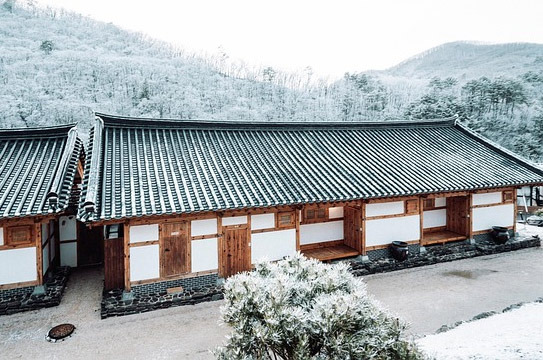
While living in the U.S., I often think of my hometown in the mountainous region of Gyeongsangdo. Especially from my perspective as someone who has made a career in architecture, the charm of the traditional Korean house, the hanok, is very appealing.
A house made of wood, earth, and tiles, with sunlight streaming into the courtyard and wind flowing in from all directions. Just looking at pictures calms my heart.
So, people around me often ask, "Can we build and live in a hanok?"
The reality is that building and living in a hanok in the U.S. is romantic but not practically easy.
The first and biggest reason is the heating and cooling issue.
Hanoks are fundamentally designed based on natural ventilation and insulation, tailored to Korea's four seasons. In winter, the ondol heats the floor by burning wood in the fireplace, and in summer, windows are opened wide to let in the breeze. However, in the U.S., especially in areas like Los Angeles or Florida where I live, the climate is different, and the housing system itself is designed for HVAC, meaning central heating and cooling. Even if you forcibly install air conditioning and heating in a hanok, the low airtightness of the structure leads to significant energy loss, reducing efficiency. Simply put, in summer, all the cool air escapes, and in winter, the warm air quickly dissipates. Energy costs skyrocket, making it practically unmanageable.
The second issue is the construction materials and building methods.
Hanoks are built with traditional materials like wood, loam, and tiles, and sourcing these materials in the U.S. is nearly impossible. Even if they are available, the import costs are exorbitantly high. You might ask if local timber could be used, but the hanok structure cannot be resolved with wood alone. Traditional construction techniques, such as joinery and tile-laying, are necessary, and how many artisans in the U.S. truly understand these methods? Even if you bring artisans from Korea to construct it, the labor and accommodation costs would make the expense of building a single house unimaginable.
The third issue is legal and regulatory problems.
U.S. building codes are fundamentally based on wooden houses or reinforced concrete structures. However, hanoks have unique features like tiled roofs, eaves, and ondol structures that are likely to conflict with current regulations. For example, if you try to install a fireplace to create ondol, it could be classified as a fire hazard, and the calculations for a tiled roof might lead to complications in the permitting process. In other words, obtaining permits is not easy.
The fourth issue is the difference in lifestyle.
In Korea, sitting in the yard to enjoy the breeze and having a cup of tea on the floor is a natural way of life, but the lifestyle patterns in the U.S. are different. Modern spaces like garages, living rooms, and open kitchens are preferred, with a clear distinction between indoor and outdoor areas. The open structure unique to hanoks is also disadvantageous in terms of privacy. Although the land is vast in the U.S., privacy is highly valued, so houses with large open windows and doors can feel unsettling.
The fifth issue is maintenance.
Hanoks are called breathing houses. This means they require constant maintenance. Wood is vulnerable to mold and insects, and tiles need regular upkeep. Even in Korea, maintenance is not easy, and if a hanok is built in the U.S., there seem to be almost no specialized companies, leading to enormous costs and efforts every time repairs are needed.
Ultimately, building and living in a hanok in the U.S. signifies that the gap between romance and reality is too wide.
As an architecture professional, I also have a dream of trying it at least once, but when considering the possibilities, various barriers such as efficiency, costs, regulations, and lifestyle patterns stand in the way. Of course, nowadays, there are modern hanoks that enhance insulation and heating/cooling while maintaining a traditional appearance. However, this is essentially a "modern house with a hanok concept," not the traditional hanok we envision.
As I grow older, I find myself thinking about my hometown more often.
"How wonderful would it be to build a hanok right in the middle of my yard in L.A.?" Just imagining it makes me feel good. But architecture cannot be built solely on romance. Costs, efficiency, regulations, and lifestyle—all these realities must be considered for it to be possible.
So, my answer is always the same. "Hanoks belong in Korea; in the U.S., it's best to just admire them in photos and long for them."





 Weekend Movie Blog |
 Beauty, Health, Lifestyle Blog |
 coloradoman |
 Superman Cat Blog |
 Awesome Blog |
  Tora Tora |
  yellowbutter |
  Dolly |
  US Embassy |
  NYC saladbar |
  Finding Superfoods |
  lightyear |
  song bang |
  vexomo |
  Indiana Jones |
  meloncat |
  novapixel |
  mortrix |
  Esther 1983 |
  fortbliss |
  Moscow Kim |
  My Two Way |
  toastyfox |
  FLORIDA Acus |
  tracker |