

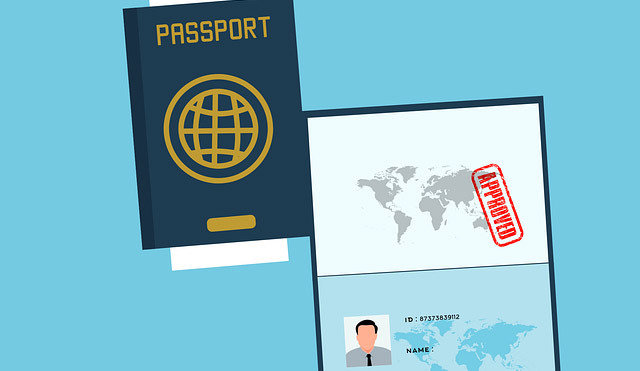
What is the first thing you should pack when preparing for a trip?
Luggage? Plane tickets? In fact, the most important item is your passport.
A passport is not just a travel permit; it is literally a 'key to the world.'
Living in the U.S. and traveling abroad, I often feel that the weight of a single passport carries more significance than just a few sheets of paper.
The concept of a passport has surprisingly existed for a long time. During the ancient Persian Empire, a travel document issued by the king is considered the prototype of a passport.
Later, in medieval Europe, clergy and merchants were issued certificates to safely cross borders.
The modern form of the passport we know today was established after World War I, as border control tightened, requiring documents that show 'who you are and where you came from.'
In Korea, even during the late Joseon Dynasty, there were documents similar to travel permits, and records of the first modern passports issued by the Korean Empire government after the opening of ports still exist. Thus, passports are not just essential items for modern travelers; they are living witnesses to the history of people crossing between nations.
As a U.S. citizen holding an American eagle passport, I often realize how powerful it is when I travel abroad.
The U.S. passport is one of the most influential passports in the world. As of 2025, U.S. passport holders can enter over 190 countries without a visa or with a simple arrival visa. It is almost accurate to say that there are no barriers to entering most European countries, Japan, Korea, and major tourist destinations in Southeast Asia.
Of course, this can change depending on international relations.
Some countries may be strict based on diplomatic relations with the U.S., and some regions still have entry restrictions. However, overall, the U.S. passport ranks at the top in terms of 'freedom to travel' worldwide. Therefore, one of the most envied passports among travelers I meet abroad is the U.S. passport.
In the past, passports were just booklets with a photo attached. This led to many forgeries, and they were easily misused if lost.
However, looking at today's passports, it is astonishing how equipped they are with advanced technology.
First, there is the electronic chip. Modern e-passports contain a chip that holds the holder's biometric information (face, fingerprints, etc.). Therefore, it is not enough to just look similar in the photo to pass through. At airport checkpoints, machines scan the passport and immediately verify the identity, making forgery nearly impossible.
Second, there are holograms and special inks. When you shine a light on the passport pages, there are sparkling holograms and patterns that are only visible under ultraviolet light. These are technologies that cannot be replicated with a standard copier.
Third, there are micro-prints and laser engravings. If you look at the patterns inside the passport with a magnifying glass, you will see very small text engraved, which cannot be achieved without precision printing technology. Nowadays, names and photos are directly engraved with lasers, making theft or alteration even more difficult.
Fourth, there are country-specific secret technologies. In fact, there are many security features in passports that are not disclosed. Some countries add special chemicals to the paper, while others embed marks that are completely invisible to the naked eye. It feels like something out of a spy movie.
A passport is not just a piece of paper used when going abroad. In my case, every time I hold my U.S. passport, I realize 'how much freedom this small booklet gives me.'
Conversely, for refugees or stateless individuals without a passport, crossing a border can become a life-threatening adventure. A passport symbolizes an individual's position in the world.
Another interesting point is that the design of a passport serves as the face of that country.
Inside the U.S. passport, there are scenes reflecting the spirit of the founding and historical moments, while the Korean passport features Hangul, the national flower, and traditional patterns. Every time I take out my passport while traveling, I inadvertently reveal the identity of that country.
The power of the U.S. passport undoubtedly provides a level of freedom recognized worldwide, but at the same time, a technological war continues to prevent passport forgery and illegal use. Perhaps the passport is the smallest yet most powerful 'national equipment.'There are talks that one day a world without passports will come. As biometric technology advances, it may be possible to pass through immigration using just an eye scan or fingerprint instead of a passport.
However, for the time being, the passport in my travel bag remains the most fundamental document.




 Weekend Movie Blog |
 Beauty, Health, Lifestyle Blog |
 coloradoman |
 Superman Cat Blog |
 Noodle Noodle |
  Cherokee Rose |
  Kor. Master |
  Holey Moley |
  Conflite Teacher |
  Hodong Prince Over Flex |
  Mist inn |
  citrus pop |
  Onion Ring |
  phoenixia |
  viewtop |
  loverun |
  Kim Do Sun |
  SEVEN SEVEN |
  yentra |
  Make My Day |
  Victory 1988 |
  Tonky |
  viroma |
  cookie |
  Live and that's it |