

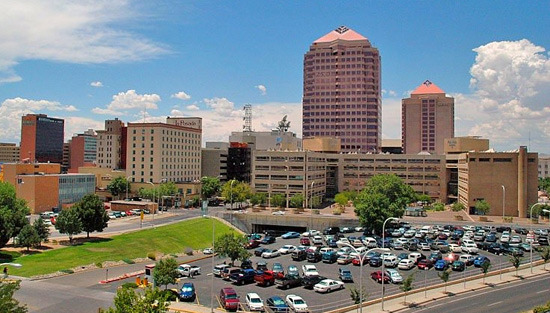
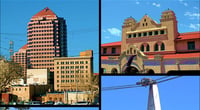
The downtown skyline of Albuquerque is not the kind of cityscape that elicits a "Wow, amazing!" reaction.
It is neither the grand scale of New York, the dense skyscrapers of Chicago, nor the shining forest of buildings in Dallas. Because it does not have towering buildings like monuments, those coming from outside may honestly feel disappointed when they first encounter downtown Albuquerque.
Here, low-rise buildings line the streets, and there are no great viewpoints for taking skyline photos. However, the value of this city cannot be judged by the height of its skyline. Albuquerque is a city that needs to be understood through its underlying economic strength and unique local balance rather than its outward appearance.
The skyline itself has chosen practicality over glamour. Instead of tall buildings, mid-rise offices and commercial buildings are spread throughout the downtown, serving as the backbone of the local economy. While the office buildings in downtown Albuquerque are not home to major corporate headquarters, they host local government agencies, healthcare and education service groups, and various professional service firms.
These institutions and businesses provide essential services and jobs for local residents, creating steady demand. The important point here is that the strength of Albuquerque's commercial real estate market lies in its "sustained stability" rather than "explosive growth."
Unlike other major U.S. cities, there is no massive influx of venture capital or a boom in high-rise construction, but Albuquerque instead has a solid foundation for its local economy. Particularly, government and healthcare institutions support the entire commercial real estate market, making it relatively resilient to economic fluctuations.
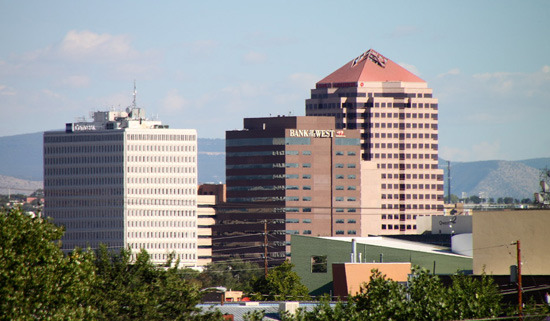
This means that the structure maintains basic demand during both good and tough economic times.
While many cities have struggled with decreased office demand after COVID, Albuquerque did not come close to complete collapse. Some vacancy rates have risen, but it has not suffered from severe vacancy issues like other major cities.
This is precisely why commercial real estate investors are paying attention to Albuquerque. While it may not offer a skyline with flashy visuals, the local economy is service-oriented, and most service providers tend to sign long-term leases, resulting in relatively stable rental income.
In particular, healthcare and education-related properties boast long-term leasing demand, making these sectors a core pillar of Albuquerque's commercial market. Large hospitals, specialized clinics, and educational research institutions are located in and around downtown, generating consistent leasing demand.
Moreover, Albuquerque is often perceived as a relatively undervalued commercial real estate market compared to the overall population and economic scale of the state. This acts as a double-edged sword for investors. On one hand, it means that high growth expectations are difficult to anticipate, but on the other hand, it can be interpreted as a lower investment risk.
This means that there is less of a phenomenon where extreme price volatility or heated investment competition raises the barriers to entry. Therefore, for medium to long-term value investors interested in stable rental cash flow, Albuquerque's commercial market can appear attractive.
Of course, it cannot be said that the commercial real estate market in downtown Albuquerque is perfect in every aspect. Some older buildings need renovation, and additional public infrastructure investment is required to revitalize the downtown. Improving public transportation access, restructuring pedestrian-friendly streets, and expanding cultural and entertainment spaces remain ongoing challenges.
However, these challenges do not necessarily detract from the appeal of the Albuquerque market; rather, there is a perspective that views them as potential for future development. Investors sometimes see these improvement possibilities as a foundation for long-term growth.
Ultimately, the downtown Albuquerque skyline should be evaluated not for its glamour but for the stability and sustainability of the urban economy. While it may not have a row of tall buildings, the steady economic activities within and the economic structure maintained beneath suggest that Albuquerque's commercial real estate market is indeed strong.




 ultron78 |
 garlic bread |
 Sugar Cream Door Bulletproof Noodles |
 urbanmint |
 |
| 
 rainyday |
 New Mexico Friends MAX |
 Say Yes in English |
  Southwestern |
 Pointy |
  Korean Mom |
  My NYC |
  moo moo |
  Mr Oh |
  forevergee |
  festival |
  manchester |
  constant |
  Leapfrog Move |
  vibranto |
  Tora Tora |
  yellowbutter |
  Dolly |
  US Embassy |
  NYC saladbar |
  Finding Superfoods |
  lightyear |
  song bang |
  vexomo |
  Indiana Jones |