

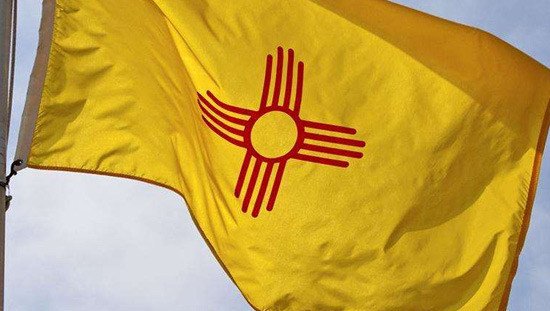
The New Mexico state flag features just one symbol, the Zia, on a yellow background.
The New Mexico state flag may seem quite simple at first glance. With a yellow background and a single strange red symbol, one might wonder, "Is this it?" There are no common stars that are typically seen on state flags, nor is there a fierce eagle, whether a bald or a golden one, and it lacks the historical embellishments that many states proudly display.
However, upon researching this flag, it becomes clear that few state flags in the U.S. so boldly assert their identity.
The yellow background is a direct legacy from the time when Spain ruled this land, and the red symbol in the center is the Zia symbol, representing the sun for the Pueblo people, not the American flag. While most states may verbally respect Native American history, they do not prominently feature it in the center of their flags.
This flag straightforwardly shows that the true owners of this land were neither Spain, nor Mexico, nor the United States.
The four rays of the Zia sun symbol represent the four cardinal directions and the four seasons, suggesting that "the time and order of this land began here."The red color is not a common symbol of patriotism or revolution; rather, it signifies the sun, life, and the cycle of life connected to blood. Placing this on a yellow background creates a visual representation of Native American identity layered over the remnants of Spanish colonization.
Typically, state flags feature the colors of the U.S. flag with historical decorations on top, but New Mexico chose an unconventional order. Thus, this flag appears more stubborn than beautiful. It conveys the message, "We were like this originally, and we still are," without needing further explanation.
There are no state names, years, or mottos beneath the flag. It reflects an attitude of, "You should know without being told." Therefore, the New Mexico flag might be one of the least American flags among U.S. state flags, yet paradoxically, it is also one of the most American flags.
New Mexico has one of the highest percentages of Native Americans in the U.S. Based on recent population data, about 9-10 percent identify solely as Native American, and when including those with Native ancestry alongside other races, the figure rises to around 11 percent.
This is a significantly higher percentage compared to the national average. Tribes such as the Navajo, Pueblo, and Apache continue to reside in large numbers, and the reservations are not merely symbolic but are maintained as actual living spaces, which is a defining characteristic of New Mexico.
Thus, in New Mexico, Native American culture is not confined to museums; it is still alive in schools, language, politics, and daily life.
There are not many state flags that do not hide the fact that they are lands layered with various ethnicities and histories, and instead, boldly assert their identity. Personally, I believe that among the unique state flags in the U.S., New Mexico's is more distinctive than those of Minnesota (complex imagery), Maryland (Baltimore family crest), Alaska (North Star), Washington (portrait), and North Carolina (unique signature). I also think it is one of the easiest state flags to draw.





 El Dorado |
 lightyear |
 Moscow Kim |
 coloradoman |
 Montgomery Mom |
 rainyday |
 Say Yes in English |
 Pointy |
 Mrs New Mex |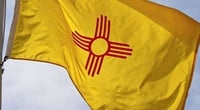
 Southwestern |
  Tonky |
  viroma |
  cookie |
  Live and that's it |
  Alright Twain |
  eatontown blog |
  HAWAII Korean Church News |
  Amore |
  linex |
  Balancework |
  laro90 |
  MEDBIO American Doctor Blog |
  SWAT TEAM BLK |
  DREAM BIG |
  frostbite |
  330 Forever My Love |
  dralix58 |
  Gorama Round |
  Skydiving |