

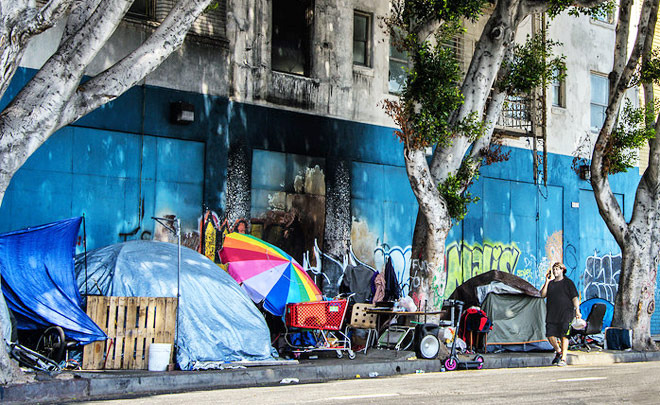
In major American cities, especially those long governed by the Democratic Party, there is a scene that always appears.
In India, there are homeless people pulling carts, tent villages in garbage heaps, and residents passing by as if they don't see them.
It becomes confusing whether this is a characteristic of that city or the official merchandise of Democratic cities.
But why are the homeless more noticeable in Democratic cities?
First of all, Democratic cities are fundamentally welfare-oriented.
They shy away from methods that forcibly remove people from the streets or put them in detention centers.
Naturally, a policy of "not forcibly evicting" emerges, which is packaged as a humanitarian approach.
The problem is that humanitarian policies operate in reality like permits for occupying the streets.
Even those who refuse treatment are considered protected, and drug addicts cannot be forcibly taken away, and mental health treatment requires consent.
Thus, the police cannot use force, and the city cannot organize the streets as it wishes.
Ultimately, "people-centered policies" unintentionally turn into policies of neglecting the streets.
Then there is the issue of housing prices. The tradition of Democratic cities is regulation and protection. Rent control, building regulations, environmental regulations, labor regulations, all sorts of regulations are firmly in place. As regulations increase, construction costs rise, supply slows, housing prices soar, the mobile class escapes, and those who cannot escape fall to the streets. So, while the policy aims to protect the working class, the reality is the decline of the working class. In the end, what was said to help the poor becomes a structure that produces more homeless people.
Moreover, Democratic cities are centered around the service industry, so the cost of living is high, but wages are lower than expected.
The rich enter tech company offices, while the poor have no choice but to sit on the streets.
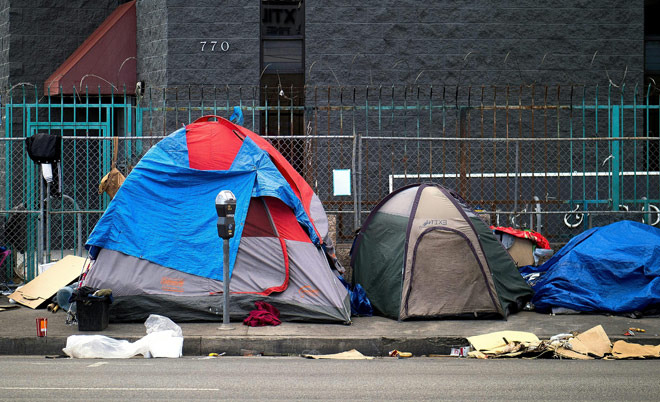
Extreme polarization is being played out in real-time in the heart of the city.
Yet, in promotional videos for the city, the phrase "a city of culture and diversity" is emphasized.
The city center is diverse. A convenience store next to a Starbucks, next to a homeless tent, right next to a Japanese restaurant. It is indeed diversity.
Additionally, there is a unique atmosphere in Democratic cities. An atmosphere that pretends to have good intentions.
Citizens pretend to worry about the homeless issue, politicians pretend to distribute budgets, and the rich pretend to donate.
However, no one wants to take direct responsibility for the overflowing homeless on the streets and solve the issue.
The entire city wants to brand itself with a "moral image."
Thus, policies that evict are seen as evil choices, while doing nothing is disguised as a good choice.
In summary, the official formula for homelessness in Democratic cities cannot be enforced. And people mistake this for "freedom and human rights."
Ironically, the most free person on the streets is the one without a home.
"While I can't provide a home, I can allow you to use humanity."







 garlic bread |
 Yo Lock Me Up |
 California Information News |

 My Town My Way Blog |
  manchester |
  constant |
  Leapfrog Move |
  vibranto |
  Tora Tora |
  yellowbutter |
  Dolly |
  US Embassy |
  NYC saladbar |
  Finding Superfoods |
  lightyear |
  song bang |
  vexomo |
  Indiana Jones |
  meloncat |
  novapixel |
  mortrix |
  Esther 1983 |
  fortbliss |
  Moscow Kim |