

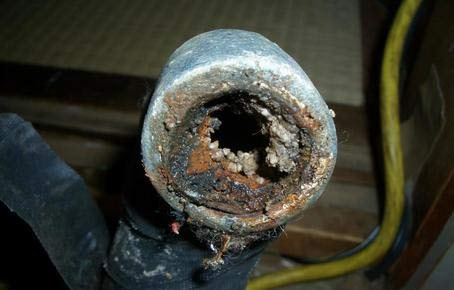
Anyway, not long ago, I turned on the faucet to take a shower... but the hot water wasn't coming out properly.
Since lukewarm water kept coming out, I gave up on the shower and opened the boiler room door, but it didn't seem to have any visible issues, so I decided to wait it out for a day.
However, the next day and the day after that, I still had to shower with cold water, so I eventually contacted a local plumber.
The plumber came, checked a few things, and then called me over. He said seriously.
"The pipe coming out of the boiler is clogged with scale. Upon checking, the condition is severe."
To be honest, I was a bit taken aback. Our house was built in the 90s, and the pipes were made of copper. I thought I was safe since copper doesn't rust...
It turns out that Denver's water has a relatively high hardness. In simple terms, it means there are a lot of limestone, calcium, and magnesium components. These minerals slowly but steadily build up scale on the walls of the pipes when they come into contact with hot water. As the boiler ages and goes through winter and summer, more minerals stick to it. Eventually, the flow of water in the pipes gradually decreases until it becomes blocked.
Our plumber was very skilled. He first tried to push out the scale accumulated inside the pipes with a high-pressure cleaner. However, the condition was more serious than expected, and some parts of the pipe needed to be replaced. In particular, the main pipe coming directly from the boiler was almost completely blocked.
In the end, replacing half of the boiler pipe and performing high-pressure cleaning... the cost came out to just over $1,800. It felt like a lot of money going out at once. But thinking about the days of washing dishes and washing my hair with cold water, I had no choice.
After that, I immediately took action. The first thing I installed was a 'boiler-specific water filter.' These days, there are quite a few small systems that can catch minerals to some extent. Installation isn't difficult, and the maintenance cost isn't that high, so I highly recommend it. Now, I also have the boiler checked every year and check the inside of the pipes. At first, I thought, 'Why do this every year?' but after experiencing an incident, my perspective changed completely.
Denver has hard water, harsh winters, and dryness, making it a perfect condition for strain on home plumbing.
Especially if you have an old house. If you think, 'Surely it won't happen to my house?' you might one day find only cold water pouring out of the showerhead.
And one more thing. When the hot water boiler pipe starts to clog, at first, it might just be a slight drop in temperature and water pressure. But if you ignore it, in a few months, it will be completely blocked. Just like a person collapses when blood vessels are blocked, pipes are similar.
So if you plan to live in Denver for a long time, boiler maintenance is essential. Installing a water filter is also a big help, and even if regular checks are a hassle, make sure to keep up with them.
Having warm water come out every day is something to be grateful for, and I've learned that well.







 Egg Steamed Pot |
 novapixel |
 xylora |
 vegas mom |
 Coco and Lulu |
 Your Curiosity Resolved |

 coloradoman |
 Jean Claude Bundang Blog |
 Nuchuhan Exploration BLOG |
  Korean Mom |
  My NYC |
  moo moo |
  Mr Oh |
  forevergee |
  festival |
  manchester |
  constant |
  Leapfrog Move |
  vibranto |
  Tora Tora |
  yellowbutter |
  Dolly |
  US Embassy |
  NYC saladbar |
  Finding Superfoods |
  lightyear |
  song bang |
  vexomo |
  Indiana Jones |