

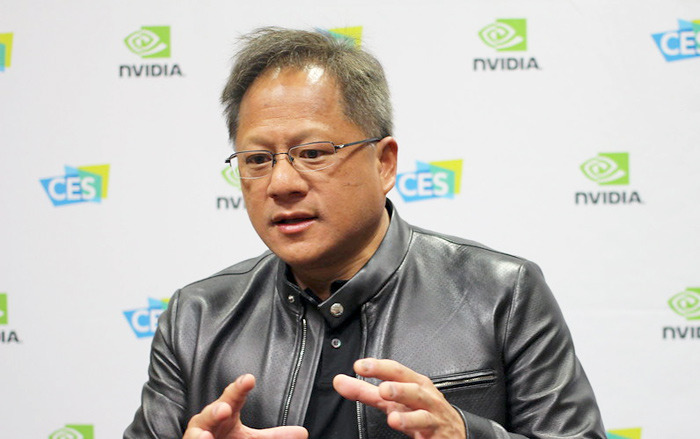
Looking into the story of Nvidia's founder Jensen Huang feels like watching a movie.
Born in 1963 in Tainan, Taiwan, he immigrated to Kentucky, USA with his family at the age of 9, later spending his school years in Oregon and becoming fascinated with electrical engineering. He earned a bachelor's degree in electrical engineering from Oregon State University in 1984 and a master's degree from Stanford in 1992.
After graduation, he built his career as an engineer designing microprocessors at LSI Logic and AMD, and in 1993, he co-founded Nvidia with his colleagues. From that point, his name began to gain recognition in Silicon Valley.
As the AI boom of the 2020s took off, Nvidia quickly rose to the center of the world. As generative AI shook the world, Nvidia's stock price, which produces the key engine in the form of graphics processing units (GPUs), skyrocketed by 197% in just one year.
By June 2024, it became the world's most valuable company, surpassing Apple and Microsoft. With an operating profit margin exceeding 80%, it became a company that was 'not enough even when sold at a high price,' and Jensen Huang established himself as one of the most watched CEOs in the world.
As a result, his wealth also exploded. According to Bloomberg's Billionaires Index in December 2024, he rose to become the 11th richest person in the world. The 'engineer in a leather jacket' from Silicon Valley has now become a symbol of global wealth.
However, as much as the growth of his immense wealth, his tax strategy has also drawn attention.
According to reports from American media, Jensen Huang is said to have avoided about $8 billion in taxes through legal tax-saving techniques. The important point here is that he utilized legal mechanisms allowed by law, and employed the methods of experts.
A typical method is a gift trust known as 'GRAT.'
This structure involves placing certain stocks in a trust and receiving only a predetermined profit each year; if the stock price skyrockets, the excess profit is exempt from taxation. In fact, the Nvidia shares that the Huang couple placed in the trust were initially around $100 million, but due to the AI boom, they grew to tens of billions of dollars in just a few years, allowing them to avoid trillions in inheritance taxes.
Another method is a trust structure called 'IDGT.'
This is designed so that the original owner continues to bear the taxes generated by the trust, allowing the inherited property to grow while reducing the owner's wealth. The use of charitable foundations and donor-advised funds (DAF) to transfer stocks while simultaneously benefiting from charitable activities and tax savings is also noteworthy. As a result, it has been evaluated that he reduced about $8 billion in taxes, which is among the most notable cases of legal avoidance in the United States.
At this point, opinions among people are divided. Some say, "There is no problem since he followed the procedures allowed by law," while others view it as unfair, stating, "Only the rich can exploit institutional loopholes that ordinary people can only dream of." In fact, Jensen Huang's case dramatically illustrates the gaps in the system that the ultra-wealthy can enjoy, rather than him being particularly cunning.
Nevertheless, his success story remains fascinating. A boy who started from a small city in Taiwan and crossed over to America has ultimately risen to the pinnacle of wealth, beyond just being the head of the world's number one company. In the process, he has established himself not just as a CEO, but as a symbol of the AI era and an icon shaking the global economy.
Looking back, Jensen Huang's life is a typical example of achieving the immigrant dream in America.
A boy born in a small city in Taiwan, who immigrated to rural Kentucky, has grown to become one of the most influential CEOs in the world. His success is becoming a catalyst for changing the global technology paradigm, beyond just personal wealth.
Even now, people ask, "Where will Nvidia go in the future?"
But perhaps a more interesting question is, "How far will Jensen Huang go in the future?"
The future of AI is the future of Nvidia, and the future of Nvidia overlaps with the vision of one person, Jensen Huang.







 Northeastern |
 Nationally Certified Lightning Charcoal Review |
 American Grape Shine Muscat |
 U.S. Weather Bureau News |
 sparkling |
  Tora Tora |
  yellowbutter |
  Dolly |
  US Embassy |
  NYC saladbar |
  Finding Superfoods |
  lightyear |
  song bang |
  vexomo |
  Indiana Jones |
  meloncat |
  novapixel |
  mortrix |
  Esther 1983 |
  fortbliss |
  Moscow Kim |
  My Two Way |
  toastyfox |
  FLORIDA Acus |
  tracker |