

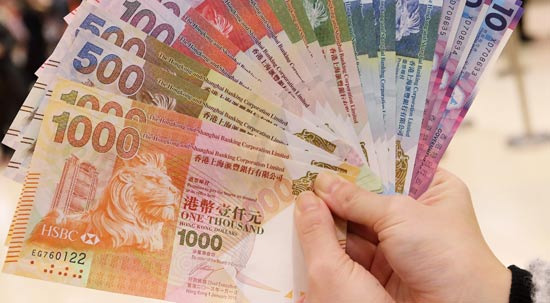
The reason the value of the Hong Kong dollar (HKD) remains stable is due to the "peg system (fixed exchange rate system)".
In other words, the Hong Kong government (specifically, the Hong Kong Monetary Authority, HKMA) artificially manages the Hong Kong dollar to maintain it within a fixed range against the US dollar.
Why does it not change much?
If the exchange rate tries to exceed this range, the HKMA intervenes by buying and selling to adjust it.
Government's automatic intervention mechanism
If the market exceeds 1 dollar = 7.85 HKD → HKMA sells dollars in the market and buys Hong Kong dollars → reduces supply to stabilize the exchange rate
Combination of capital liberalization + fixed exchange rate
Foreigners can freely move capital, but since the exchange rate is fixed → it provides a stable investment environment.
For reference, the exchange rate policies of the Hong Kong dollar (HKD) and the Chinese yuan (CNY) are completely different. One is close to a free market but is a fixed exchange rate system (peg), while the other is strongly controlled by the government under a managed floating exchange rate system.
Hong Kong maintains its status as an international financial hub through foreign exchange freedom and financial transparency, while China manages the value of the yuan to secure its manufacturing export competitiveness and economic stability.
Countries Using USD Peg System (Fixed Exchange Rate System)
There are quite a few countries around the world that use a peg system to the US dollar (USD). The reasons for using this system include exchange rate stability, trade reliability, and inflation control.
While the dollar peg provides stability, it is significantly affected by US interest rates, leading to a loss of independence and frequent inability to adjust exchange rate policies. |






 El Dorado |
 lightyear |
 Moscow Kim |
 coloradoman |
 Montgomery Mom |
 Living Economy Information Blog |
  California Kangaroo |
 U.S. Weather Bureau News |
 Tarzan's Joyful Imagination |
 Breaking Bad Drama |
  Tonky |
  viroma |
  cookie |
  Live and that's it |
  Alright Twain |
  eatontown blog |
  HAWAII Korean Church News |
  Amore |
  linex |
  Balancework |
  laro90 |
  MEDBIO American Doctor Blog |
  SWAT TEAM BLK |
  DREAM BIG |
  frostbite |
  330 Forever My Love |
  dralix58 |
  Gorama Round |
  Skydiving |