


One of the most confusing aspects of the US legal system for Koreans is the sentencing guidelines.
In some cases, a person can commit murder and serve only a few years, while in others, they may spend their entire life in prison. Even for the same crime, the outcomes can vary by state, judge, and jury decisions.
This is why people often say, "In the US, the sentencing for murder is arbitrary depending on various criteria."
However, there are instances where US courts impose severe sentences for cases that seem to cross a line. A recent firebombing incident in Boulder, Colorado, is a prime example.
This incident occurred in June 2025 in Boulder, Colorado. The suspect was Mohamed Sabry Soliman, an Egyptian national. According to US federal authorities, he entered the country on a tourist visa and overstayed his allowed time.
But this was not a simple crime of passion. Prosecutors stated that he had been planning the attack for nearly a year.
On the day of the incident, he disguised himself as a gardener and approached Pearl Street in downtown Boulder, where a Jewish community rally was taking place in support of the release of Israeli hostages held in Gaza. This rally had been occurring weekly since the Hamas attacks in 2023.
Soliman shouted "Free Palestine" as he threw firebombs filled with gasoline. He had prepared 18 firebombs but only threw two, which caused chaos at the scene. Karen Diamond, who was 82 years old at the time, suffered severe burns and ultimately died weeks later in extreme pain. Additionally, 12 others were injured, and bystanders were also recognized as victims. Even a dog present at the scene was burned, leading to animal cruelty charges.
In the US, due to the high number of gun-related incidents, people can become desensitized, but this case felt different.
It was not just a simple murder; it had a strong atmosphere of planned, politically and religiously motivated terrorism. Prosecutors claimed that Soliman had attempted to purchase a firearm twice but failed, leading him to decide to burn people alive instead. In court, the judge strongly criticized him, stating, "He chose the time, place, and weapon to inflict as much pain as possible."
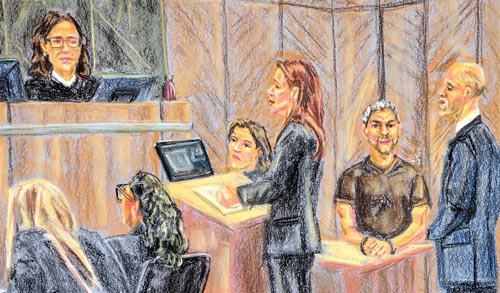
Ultimately, he was sentenced to life without parole.
In the US, there are different types of life sentences. Some allow for parole after a certain period, but this case means he will not be released until he dies. Additionally, he received hundreds of years added to his sentence for attempted murder, assault, and terrorism-related charges.
This highlights the peculiarities of the US criminal justice system. Some murders result in a few years of imprisonment, while others receive lighter sentences than drug offenses or theft.
However, when political hatred, racial or religious conflict, and planned terrorism are involved, sentences can suddenly become very severe. Hate crimes against Jews are particularly sensitive in American society.
Interestingly, this case is not entirely resolved. He is also facing federal hate crime charges, and federal prosecutors are considering the death penalty. In the US, state and federal trials can proceed simultaneously, meaning that one incident can lead to ongoing penalties.
On the other hand, the defense attorneys argue that he did not hate Jews themselves but opposed Zionism. This is because US law has ambiguous applications for hate crimes related to political views. However, according to FBI statements, Soliman reportedly told police after his arrest that he wanted to "kill all Zionists." Such expressions are considered highly damaging in American society.
Another shocking aspect for many was the family situation. His wife and children were detained in an immigration facility for several months due to this incident, and they are currently undergoing deportation proceedings.
Honestly, when observing the US criminal justice system, it often feels inconsistent. It seems that having money and a good lawyer can lead to reduced sentences, and the atmosphere of verdicts can vary by region.
However, in cases like this one, where the attack is deemed "deliberately intended to instill fear and maximize harm," US courts can impose very harsh sentences. Particularly, incidents involving religious or racial hatred are viewed as attacks on society as a whole, leading to significantly increased sentences.
Ultimately, in the US, sentencing is not determined solely by the fact that someone "killed a person."
Factors such as how premeditated the act was, the level of social fear it caused, whether there were political or religious motives, and the extent of the harm all play a role.
This is why, when watching US news, you can see cases where some people serve a few years for murder while others must spend their entire lives in prison.
 ShrimpPower
 ONTIME







 Sugar Cream Door Bulletproof Noodles |
 Investment Campus Home Ownership |
 U.S. Retirement Pension Information |
 California Dreamer |

 Your Curiosity Resolved |
 Jellia Angel |

 Nuchuhan Exploration BLOG |
 Study Abroad Life Know-How Tips |
  cheesepup |
  carpflow |
  mapsina |
  Softy |
  Mr. Largo |
  breezem |
  Omelet Rice for Strength |
  Vermont Capt |
  waltz |
  Shoot Me |
  Michigan Enthusiast |
  festive |
  Supplemental Security Income (SSI) Information |
  Sams Market |
  ansdal |
  VVV 80 |
  BIODOCTOR NEWS |
  Gold Bar |
  Tamfa Fan |