
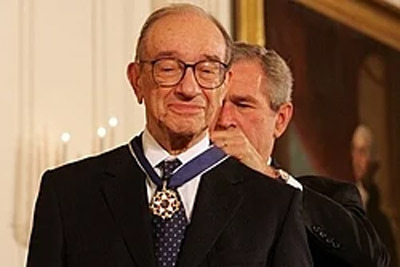
Alan Greenspan, the former chairman of the Federal Reserve (Fed), has passed away at the age of 100.
His wife, journalist Andrea Mitchell, stated that he died at home due to complications from Parkinson's disease.
To Americans, Alan Greenspan was more than just an economist.
He served as the chairman of the Federal Reserve from 1987 to 2006, spanning an impressive 18 and a half years, under four presidents: Reagan, Bush, Clinton, and George W. Bush.
During that time, the U.S. economy experienced a golden era.
The dot-com boom of the 1990s occurred, unemployment rates fell, and inflation remained relatively stable.
On Wall Street, he was referred to as the "Maestro," implying that he was the one orchestrating the U.S. economy like a conductor leading an orchestra.
However, his life also had its dark chapters.
The 2008 financial crisis changed everything.
Many economists criticized the financial deregulation and prolonged low-interest policies that Greenspan championed for contributing to the housing bubble. Ultimately, the subprime mortgage crisis occurred, leading the U.S. to face the most severe financial crisis since the Great Depression.
Notably, during a congressional hearing, he effectively admitted, "There was a flaw in my thinking that financial institutions could regulate themselves."
At the time, the U.S. media referred to this as the "confession of the economic emperor."
Another controversy surrounding Greenspan was his overly complex way of speaking.
When reporters asked questions, he often avoided clear answers and repeated vague expressions.
In the U.S., there was even a joke that said, "If you understood what Greenspan said, you misunderstood it."
Yet, the market reacted strongly to his every word.
Some people regard him as a genius who brought prosperity to the U.S. economy.On the other hand, some criticize him as the one who sowed the seeds of the financial crisis.
One undeniable fact remains: he left an enormous mark on the history of the U.S. economy.
Even after living for 100 years and passing away, economists and investors still discuss his name, and that is the reason why.
 CrustUnicorn
 HamstrCopter



 Sugar Cream Door Bulletproof Noodles |
 Investment Campus Home Ownership |
 U.S. Retirement Pension Information |
 California Dreamer |
 El Dorado |
 Eldorado 88 |
 Holey Moley |
 Ohio Ohayoung Hello |
  parlon |
  Shoot Me |
  Michigan Enthusiast |
  festive |
  You Turn Me On |
  Supplemental Security Income (SSI) Information |
  Sams Market |
  ansdal |
  VVV 80 |
  BIODOCTOR NEWS |
  Gold Bar |
  Tamfa Fan |
  Jenny's Mom blog |
  Karina's Blog |
  Best Frozen Yogurt |
  Victory 1988 |
  Coding Elf |
  Infinite Style |
  Mr Cleveland |