

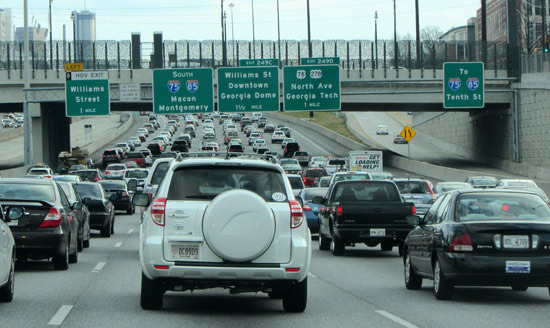
People who have driven in Atlanta can probably relate to this story.
When gas prices were lowered, I thought it would ease the situation a bit, but the reality is far from that. Governor Brian Kemp signed a policy on March 20 to suspend the fuel tax for 60 days, reducing the burden by about 33 cents per gallon, but the situation on the roads remains unchanged.
Even with slightly lower gas prices, it becomes clear once again that the roads are not getting any clearer.
Traffic congestion in Atlanta is already considered one of the worst in the United States.
Recent surveys have ranked it fifth in the nation based on congestion levels. The most serious issue is the bottleneck areas. The so-called spaghetti junction where I-285 and I-85 meet is ranked third in the nation, and when you combine the northern section of I-75 and I-285, as well as the western section of I-20 and I-285, four of the top ten worst spots in the country are located in Atlanta. This is not just a matter of "a little congestion"; it should be seen as a structural problem.
In reality, a trip that should take 20 minutes often takes at least 40 minutes. During rush hours, it can take even longer. Annually, it is said that a single driver wastes about 80 hours on the road. This translates to nearly six hours of congestion every day. This is not just an inconvenience; it significantly impacts the quality of life.
Since the 1996 Olympics, Atlanta has seen rapid urban development and a swift influx of population, leading to a surge in traffic volume, and by the 2000s, the image of being a "perpetually congested city" began to take shape.
So why has it gotten this bad? The biggest reason is population growth... The influx of people into major U.S. cities is indeed a problem without a solution.
Metro Atlanta has rapidly grown in recent years, with logistics and population both increasing, and as warehouses and distribution centers have multiplied, truck traffic has surged, significantly increasing the burden on the roads.
On top of this, there are issues with public transportation. While MARTA exists, its routes are limited. The lack of efficient connections from the outskirts to Midtown or Downtown means that most people have no choice but to rely on their cars. As a result, the number of vehicles continues to rise, and the roads cannot handle the load.
Another issue is the road structure itself. Atlanta is a city with a complex highway system.
There are many areas where multiple interchanges are clustered together, so even a small accident can lead to a chain reaction of congestion. Especially in places like the spaghetti junction, the complex layout makes it inevitable for first-time drivers to slow down.
What's frustrating is that while the fuel tax was temporarily eliminated, the burden of gas prices has decreased, but vehicle movement has actually increased.
As driving costs go down, people are encouraged to take their cars out more, resulting in no reduction in traffic volume. It becomes clear that this is not a problem that can be solved with just one policy.
Ultimately, I believe that Atlanta's traffic issues are not simply a matter of "the roads are congested"; they are a complex problem intertwined with urban structure, population growth, logistics flow, and a lack of public transportation. Without fundamental changes like expanding public transportation or improving road structures, this situation is likely to continue repeating itself.






 |
| 
 Premium Gas Camp |
 CA Real Estate |
 cheesepup |
 breezem |
 Let's Be Like a Salt-like City Person |
 Korea Tiger News |
 Dingho and USA News |
 Cherokee Rose |
 SPACE SHIP |
  newyorker 101 |
  coffeee |
  |
|  Christopher |
  sylven |
  Sammy Beach |
  Bliss O |
  blue ocean |
  greenlight |
  Watanaka Karametibaksa |
  castle |
  xelton52 |
  carefree |
  vrixen73 |
  AZ Road Master |
  Victory 1988 |
  summita |
  business lim |
  Colorado Lee |
  Make My Day |