

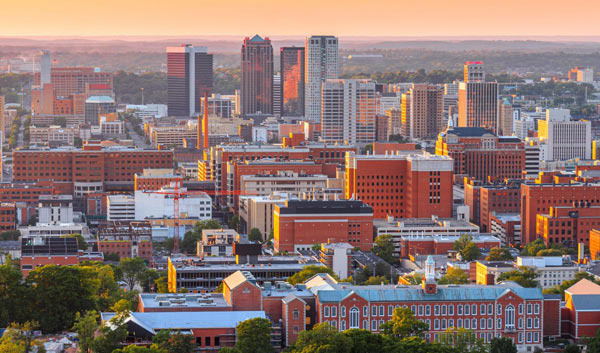
It seems that there are always aspects of a city that you don't fully understand until you live there.
The image you see on the surface often differs significantly from the actual experience. Birmingham, Alabama, seems to be a similar city. From an immigrant's perspective, there are certainly advantages, but there are also quite realistic downsides. Understanding this gap beforehand can make settling in much easier.
Starting with the advantages, the most noticeable is probably the cost of living. It's about 10-15% lower than the national average, so you can immediately feel the difference in your monthly fixed expenses. Particularly, housing costs are relatively low, allowing you to live in a larger and more comfortable home on the same income. Since the size of a home and quality of life in the U.S. are closely linked, this aspect seems to play a more significant role than expected.
Another notable point is the University of Alabama at Birmingham, commonly known as the UAB system. This institution has a national impact in the medical and research fields, providing quite realistic opportunities for immigrants considering careers in healthcare or research. It seems significant that there is a foundation for continuing a career, not just a job.
The educational environment is also fairly decent. If you move to the suburbs rather than the city center, public schools tend to be quite stable, and in some areas, they feel competitive compared to the national average. Additionally, Alabama's tax structure seems to play a role here. With property taxes around 0.4% and income tax capped at about 5%, it appears to be less burdensome for accumulating assets in the long run.
The local atmosphere is surprisingly pleasant. It's not completely rural, nor is it as chaotic as a big city. It feels like a blend of the relaxed relationships typical of small towns and the openness characteristic of college towns. Initially, there may be concerns about safety, but it seems that the differences depend significantly on the area you choose. Moving to the suburbs can provide a stable environment that meets national averages.
Another practical advantage is the location. It's about a 2.5-hour drive to Atlanta, so you can utilize the infrastructure of Atlanta, Georgia, when needed. Access to a major airport, a Korean community, and various shopping and cultural facilities can be surprisingly helpful. It's easy to understand the structure of living quietly most of the time while using the big city when necessary.
However, there are definitely downsides. The first thing you notice is the dependence on cars. Public transportation is virtually non-functional, so having a driver's license and a vehicle is almost essential. In the early days of immigration, not having a car can make daily life feel quite restricted.
The language environment is also somewhat limited. There aren't many immigrant support services, including Korean, so the reliance on English is high when dealing with medical, legal, and administrative tasks. This can be more stressful than expected.
In terms of convenience, the lack of Korean infrastructure is quite noticeable. Since there are no large Korean supermarkets, you often have to travel to Nashville, Tennessee, or Atlanta to find proper Korean ingredients. While this doesn't happen frequently, it can be inconvenient when the need arises.
International travel can also be a bit cumbersome. There are no direct flights, so most trips to and from Korea involve a layover in Atlanta. You have to endure longer travel times and increased fatigue.
The climate is also hard to ignore. Summers are hot and humid, often feeling longer and more intense than in Korea. Additionally, natural disasters like tornadoes need to be considered, so preparation in advance is necessary.
Ultimately, Birmingham seems to be more of a "reasonable choice for those whose conditions fit" rather than a perfect city. It's a much more realistic approach to understand both the advantages and disadvantages before coming. If you can establish your residence in the suburbs, connect with the local community, and effectively utilize key infrastructures like UAB, it seems like a city where settling down can go more smoothly than expected.







 moo moo |
 ultron78 |
 garlic bread |
 Sugar Cream Door Bulletproof Noodles |
 urbanmint |
 toastyfox |

 Alabama Bang |

 Skyline |
  productionblog |
  What can make money? |
  Oklahoma Hoya OK |
  prixon74 |
  Roman Pan |
  USALATU BLOG |
  Sunshine Blog |
  Minnesota Small Business |
  Strawberry Pancake Warrior |
  amolayo |
  korvon |
  Que Buena |
  virexo |
  silverpath |
  Komet Park |
  reliable |
  vexo90 |
  As Always Today |
  veltar87 |
  United States National Administrative Organization Stories |