

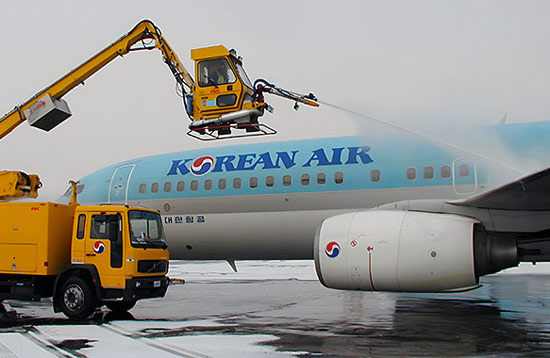
These days, winter in Korea seems really cold. Especially in January, when I return from Korea, I often see scenes at Incheon Airport where a liquid is sprayed all over the wings of the airplane. At first glance, it looks like they are washing the plane, and I wonder if it's really safe. What they are spraying is called de-icing solution. It's not just water; it removes ice and frost and prevents it from freezing again.
The key ingredient in the de-icing solution is from the glycol family. The most commonly used are propylene glycol and ethylene glycol. Both of these components lower the freezing point of ice. Simply put, while water freezes at 0 degrees, when these components are mixed in, it prevents freezing at much lower temperatures. It melts the ice or snow stuck to the aircraft wings and prevents ice from forming again while waiting on the runway.
However, these days in the U.S., propylene glycol is used more than ethylene glycol. The reason is due to toxicity.
Ethylene glycol is also used in automotive antifreeze and is harmful to humans and the environment. In contrast, propylene glycol has relatively low toxicity and is used in small amounts in food, cosmetics, and pharmaceuticals. Of course, this doesn't mean it's safe to consume, but it's a choice made to reduce environmental pollution around airports.
The smell during de-icing operations is sweet yet somewhat chemical-like. The reason is simple: it's due to the main ingredient, glycol. In particular, propylene glycol has a sweet characteristic, so when it spreads in the air, it can smell similar to syrup or sugar water. Some people even describe it as smelling like maple syrup.
Additionally, the small amount of corrosion inhibitors and surfactants mixed in also affects the smell. These ingredients are added to protect metal parts and ensure the solution spreads evenly over the wing surface, which can result in a slight oily or detergent-like scent mixed with the sweetness.
This smell is not particularly strong. In most cases, it's just a brief whiff near the window seat. However, in enclosed spaces or when there's no wind, it can feel a bit stronger. Still, it is managed to ensure it's not harmful to humans. U.S. airports and airlines strictly adhere to exposure standards for passengers during de-icing operations.
The de-icing solution is also distinguished by its color. Clear or orange-tinted solutions are for removing frozen snow and ice, while green or yellowish solutions are anti-icing solutions. Anti-icing is more about prevention than removal. It leaves a thin protective layer on the wings just before departure to prevent ice from forming again until takeoff.
The importance of this chemical is that even a very thin layer of ice on the wings can significantly reduce lift. Even a slight amount of ice can disrupt airflow, creating dangerous situations during takeoff. Therefore, U.S. aviation regulations require de-icing whenever there is any doubt during winter. It can be costly and cause delays, but safety is not a matter of choice.
One reason domestic flights are often delayed in winter is precisely because of these de-icing operations. On snowy days, when many planes are at the airport, there can be a shortage of de-icing trucks, causing delays in the queue. However, the fact that this process is not skipped shows how much the aviation system prioritizes safety. The next time you see someone spraying something on the wings from your window seat, just remember it's not just water, but the last safety measure to get the plane in the air.







 candytip |
 Gold Bar |
 Pirate Ship Popcorn Maker |
 Montgomery Mom |
 Anjollinya Blog |
 garlic bread |
 Yo Lock Me Up |
 California Information News |
 My Town My Way Blog |
  Korean Mom |
  My NYC |
  moo moo |
  Mr Oh |
  forevergee |
  festival |
  manchester |
  constant |
  Leapfrog Move |
  vibranto |
  Tora Tora |
  yellowbutter |
  Dolly |
  US Embassy |
  NYC saladbar |
  Finding Superfoods |
  lightyear |
  song bang |
  vexomo |
  Indiana Jones |