
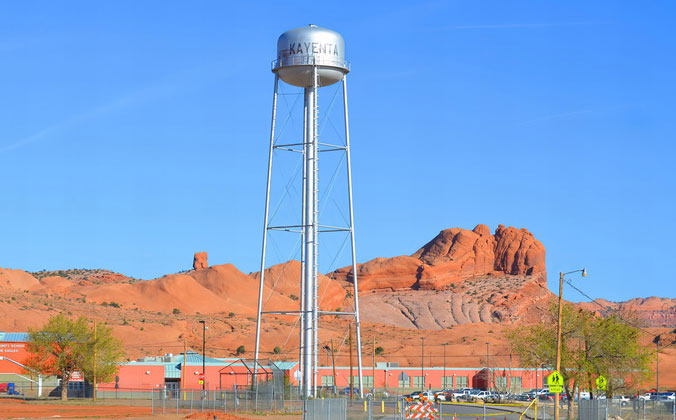
As you pass through the Arizona desert, there are noticeable structures in the middle of neighborhoods or next to houses.
It's a large water tank with legs, resembling a giant can hanging in the air. First-time viewers might wonder, "Why is this here?" and at first glance, it may seem like a metal sculpture that disrupts the urban atmosphere.
However, this water tank is a survival device essential for living in the desert. In Arizona, relying solely on underground water pipes is not easy, so the method of storing water above ground is commonly seen throughout the region.
Water is scarce in the desert. Unless you are in a city near a river or lake, the norm is to draw from underground water. The problem is that the amount of groundwater is inconsistent, and electricity is needed to run the pump to draw it up. What happens if the pump breaks down or there is a power outage? Water supply can be completely cut off.
Therefore, in many areas of Arizona, they create a 'storage space' for water above ground. While it can be stored underground, the hot climate poses significant issues with mold, temperature control, and maintenance costs for underground storage. In contrast, an elevated water tank has a simple structure, is easy to maintain, and can deliver water using gravity when needed. In other words, it serves as an 'emergency lifeline' that can supply water without a pump.
Another important reason is the issue of water pressure. Arizona has many wide plains and areas with varying elevations. If water is supplied only through pipes, the water pressure can vary by region, leading to insufficient water flow in some homes. By installing a water tank at a high position, a consistent water pressure is created due to gravity, allowing for stable water supply despite differences in distance or elevation.
The reason water tanks stand out in Arizona desert towns is also due to the low buildings. With few high-rise structures, it is natural for tall structures to stand out. In fact, water tanks are often among the tallest structures in the neighborhood.
As a result, water tanks are sometimes decorated with the town's name, mascots, or team logos, making them a 'local landmark.' For example, when entering a small desert town, seeing the town name on the water tank can give you a sense of, "Ah, this is the right place." The tank, originally built for survival, has now become the face of the community.
What would happen if this water tank were absent? The issue becomes apparent during a 'crisis' when it is usually not visible. For instance, if there is a sudden heatwave that causes a spike in water usage, the pump system alone may not be able to handle the supply. However, if there is a water tank, the stored water can compensate for the shortfall.
Conversely, if heavy rain temporarily contaminates the purification facilities, the stored water in the tank can help avoid a water shortage. It is literally a crisis response system and a water supply stabilization device. When water issues arise in the desert, daily life can quickly come to a halt, making the presence of water tanks directly linked to the survival of the community.
The water tank next to a house in the Arizona desert is not just a 'strange-looking structure' but an essential infrastructure that ensures survival, stability, water pressure, and residential convenience. The reason the water tank is elevated is to supply water without a pump, facilitate temperature control, maintain consistent water pressure, and prepare for emergencies. Thanks to this, cities can function and people can maintain their daily lives even in the heart of the desert.






 Kitchen Ideas |
 Toaster Pizza Magic Show |


 The Long Shot |
  Korean Mom |
  My NYC |
  moo moo |
  Mr Oh |
  forevergee |
  festival |
  manchester |
  constant |
  Leapfrog Move |
  vibranto |
  Tora Tora |
  yellowbutter |
  Dolly |
  US Embassy |
  NYC saladbar |
  Finding Superfoods |
  lightyear |
  song bang |
  vexomo |
  Indiana Jones |