
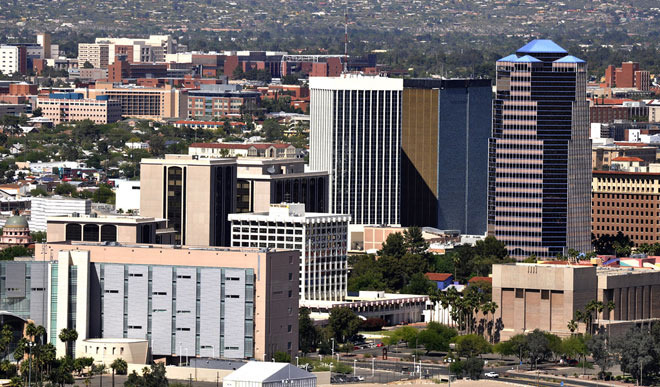
When you first visit Tucson, it's easy to think of it as a 'small city in the desert.'
There are not many flashy skyscrapers like in Phoenix, nor is there a bustling atmosphere filled with tourists.
However, Tucson is currently an interesting city growing at its own pace. The most notable feature of Tucson's economy is that it is a 'technology city centered on electronics, aerospace, and defense industries.' Tucson is home to Davis-Monthan Air Force Base, an important military facility in the southwestern United States, as well as missile-related facilities of the U.S. Army.
Additionally, large defense companies like Raytheon are established here, making the region significant for jobs and investments related to missiles, aviation, and military technology. In other words, Tucson's economy is sustained more by 'advanced defense industries' than by tourism. Contrary to the typical image of a desert city, this place can be seen as a strategic industrial hub with high technology and specialized personnel.
The second pillar is that it is a university-centered city. The University of Arizona plays a very large role in Tucson's economy. Beyond being a simple educational institution, it serves as an engine for various research industries such as optics, space science, medicine, and biotechnology. Thanks to this university, Tucson attracts a young population and creates opportunities for high-level research positions and startups.
Another background for Tucson's growth is its strategy of 'not accelerating excessive development.' While Phoenix is expanding rapidly due to massive population influx and a development boom, Tucson has focused on stabilizing its local industrial structure by relatively slowing down its development pace. It expands its infrastructure slowly without being swayed by outside investments. As a result, there is relatively less pressure on housing prices and concerns about public safety, and it is evaluated that the stability of life felt by local residents is high.
However, Tucson's economy also has weaknesses. First, there is an excessive dependence on the defense industry. If defense budgets decrease or policies change, the local economy could be significantly shaken. Second, there are not many large corporations, and the private industry is limited to defense and education. In other words, it will take more time for the city's economy to diversify. Third, compared to Phoenix, it may attract less investment attention, leading to slower growth. This could be an advantage, but it also poses a risk in terms of urban competitiveness.
Nevertheless, Tucson is learning stability as it grows at a slow pace. If Phoenix represents a flashy advance, Tucson embodies quiet cumulative growth. Rather than being a rapidly rising city, it is a city that builds its foundation, making it a reliable long-term growth model.
A solid defense industry, university-based technical workforce, stable population structure, and a development policy that does not rush. I think Tucson's economy resembles a cactus firmly rooted in the middle of the desert.
Ultimately, Tucson's economy is an example of a 'quietly strong city.' Although the city does not shine brightly on the surface, I believe that a place that masters core technologies and research will survive longer in the future.






 Who's watching? |
 AZ Road Master |

 DREAM BIG |
  frostbite |
  330 Forever My Love |
  El Dorado |
  dralix58 |
  Gorama Round |
  Skydiving |
  dreamport |
  Yellow Snowman |
  Toaster Pizza Magic Show |
  velvetnom |
  Anytime Journey |
  Mrs. Duluth |
  jaxter |
  Atlanta Mama |
  Baguette Blog |
  Tan Sol |
  US Embassy |
  Korean Mom |
  My NYC |