

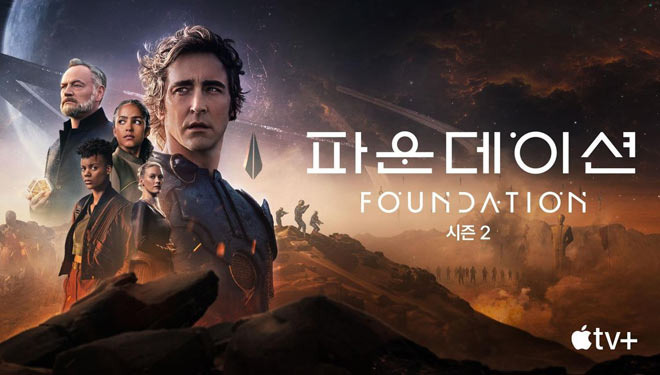
Shakespeare of Reason, Isaac Asimov
A novel written decades ago has finally begun to breathe on screens today. This is the story of Isaac Asimov.
The works left by Asimov during his lifetime were recognized as masterpieces from the time of publication, but they repeatedly faced setbacks at the gateway of adaptation.
The Foundation series, which spans thousands of years across the galaxy, and the Robot series, which deals with the philosophical dilemmas arising from human-robot coexistence. To bring this narrative to the screen required a scale of visual expression that was unimaginable with the technology of the time. Asimov's universe had to remain a world that existed only in the minds of readers for a long time.
However, times have changed. With the rapid advancement of computer graphics technology, that barrier has been broken, and at the pinnacle is Apple TV+'s Foundation. The grand narrative of mathematician Hari Seldon predicting the collapse of the Galactic Empire through psychohistory and establishing a foundation on the fringes to preserve the knowledge of civilization has finally unfolded before our eyes.
The scale of the planetary city of Trantor, the power structure of the empire leading to the cloned emperor, and the survival stories of pioneers living in the desolate Terminus. The diverse appearances of civilizations are convincingly realized with movie-level graphics, bringing the vast worldview of the original work to life.
This work goes beyond a simple space adventure because it breaks down the walls of people's thoughts.
How does civilization collapse and how does it begin again? What significance does an individual's choice hold in the face of great history?
The questions Asimov posed half a century ago are conveyed to millions of viewers through the screen, prompting people to reflect on the future, technology, and humanity.
Isaac Asimov's works center on concepts and philosophy rather than flashy events.
This development has become an important trend in modern science fiction. Here are five of Asimov's representative works that have been adapted into films.
I, Robot, 2004
A film based on Asimov's short stories and the 'Three Laws of Robotics.' While the plot differs significantly from the original, it explores the core themes of the relationship between humans and robots, trust in technology, and control, all wrapped in modern action. This is his most widely recognized work among the public.
Bicentennial Man, 1999
A story depicting a household robot gradually gaining emotions and identity, ultimately being recognized as human over a long period. It deeply poses the question of what it means to be human, and is regarded as the most emotional film among Asimov's works.
The Positronic Man, 1993 TV Movie
An early TV movie based on the same original work as 'Bicentennial Man.' Although the production scale is not large, it faithfully captures the philosophical themes of robot identity and human rights.
Nightfall, 2000
A story about a planet that has lived under six suns experiencing night for the first time, leading to the collapse of civilization in fear and chaos. This work showcases Asimov's unique concept-centered narrative, illustrating how dependent humans are on their environment.
Foundation (TV Series)
This is significant as the first large-scale adaptation of his representative work. It deals with the fall of the Galactic Empire and the reconstruction of human civilization, realizing a worldview that was once considered impossible with modern technology.
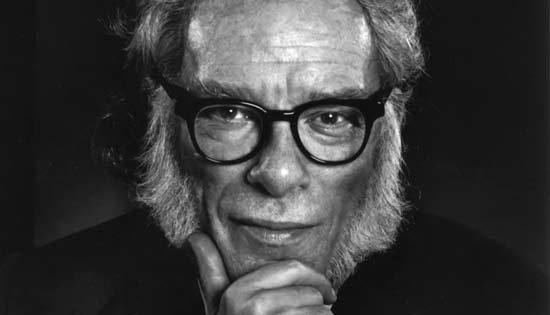
This raises a question. If Shakespeare is a genius of literature, what is Asimov?
Shakespeare was a genius who touched human emotions.
Love and jealousy, ambition and revenge.
He brought the most primal emotions of humanity to the stage, resonating with audiences even hundreds of years later.
In contrast, Asimov was a genius who touched human reason. He wielded logic instead of emotion, and thought experiments instead of tragedy.
The fact that he wove dozens of stories from the well-known Three Laws of Robotics is the pinnacle of logical imagination.
His attempt to predict the future of civilization through the fictional discipline of psychohistory shows the farthest horizon that reason can reach.
If Shakespeare asked, "What does it mean to feel?" Asimov asked, "What can humans do?"
Interestingly, Asimov's stories leave a deep aftertaste the more you think about them.
Questions like "Where is humanity headed?" and "Will technology save us or dominate us?" provide us with more lasting food for thought than flashy action scenes or cool lines.
Thus, his works evoke a sense of the extraordinary.
While most authors center their narratives around individual stories, Asimov makes the entire civilization the protagonist of his tales.
His perspective, which tells the flow of hundreds of years rather than a single life and shows historical patterns rather than a single event, is a unique viewpoint that only a writer who is both a scientist and a philosopher can possess.
Once, science fiction was a genre for a select few enthusiasts, but now it has become a narrative form that the public naturally accepts.
Concepts like artificial intelligence, robots, and future societies are no longer unfamiliar.
I believe that as reality catches up with his imagination, the audience's level has also risen.
Perhaps Asimov's true genius lies in having shown in advance what dilemmas humanity would face with technological development.
And those questions are increasingly resembling the issues we are actually facing today with AI, ChatGPT, and robotics, alongside the development of humanoid robots.
If Shakespeare immortalized human emotions, Asimov can be said to be the writer who expanded human reason into the future.
Every time I read his works or encounter them through video, I feel not just simple enjoyment but a profound question about how far humanity can go. Thus, I feel that his strange and grand stories still seem to be alive in the present tense.
I think the flow of time will reveal whether you and I, the readers of this article, will live in the world Asimov envisioned or in a world where different perspectives emerge as variables.





 Day by day |
 Kitchen Ideas |
 Iowa Egen Aunt |
 Beauty, Health, Lifestyle Blog |
 Always Atlanta |
 U.S. Weather Bureau News |
 Things to know |
 Premium Gas Camp |
 Texas Real Estate Blog |
 action blog 101 |
  Korean Mom |
  My NYC |
  moo moo |
  Mr Oh |
  forevergee |
  festival |
  manchester |
  constant |
  Leapfrog Move |
  vibranto |
  Tora Tora |
  yellowbutter |
  Dolly |
  US Embassy |
  NYC saladbar |
  Finding Superfoods |
  lightyear |
  song bang |
  vexomo |
  Indiana Jones |