

The University of Chicago is one of the prestigious private universities that has earned its reputation for 'intellectual depth and academic integrity.' It is often compared to traditional Eastern elite schools like Harvard, Yale, and Princeton, but is renowned for its educational philosophy that emphasizes relentless inquiry into academic subjects over a flashy campus and principles and philosophy over practicality. Thus, the University of Chicago is referred to as a school that "truly educates" among American universities.
Founded in 1890 with the support of the Rockefeller Foundation, the University of Chicago set out with the goal of transforming the framework of higher education in the United States. At that time, universities were centered around liberal education, but the University of Chicago was the first to introduce a graduate-centered research system, creating the model of a 'Research University.' Essentially, the research-centered structure of American universities as we know it today began at the University of Chicago.
One of the biggest reasons this school is considered prestigious is its 'Intellectual Rigor.' Students at the University of Chicago do not simply memorize or learn practical knowledge; they delve deeply into the origins and logic of concepts. For example, in economics classes, they do not just learn about supply and demand curves but start with the philosophical question, "What does it mean for a market to exist?" This educational style can be daunting at first, but over time, students' logical thinking and analytical skills grow remarkably.
Another reason the University of Chicago is regarded as prestigious is the number of Nobel laureates. To date, more than 100 individuals associated with this university, either as alumni or faculty, have received Nobel Prizes. Particularly in economics, it holds an overwhelming record. The term 'Chicago School of Economics' that we are familiar with originated from this school. Concepts such as free-market economic theory, rational choice theory, and monetarism all emerged from the research of the University of Chicago faculty. World-renowned economists like Milton Friedman, Gary Becker, and George Stigler taught here, and their students went on to lead policies in various countries around the world.
However, the reputation of the University of Chicago is not limited to economics. It continues to lead research in almost all academic fields, including physics, sociology, political science, law, and philosophy. Notably, in 1942, Professor Enrico Fermi of this school successfully conducted the world's first nuclear reactor experiment, achieving the first artificial nuclear fission in human history. This experiment later led to the Manhattan Project and completely changed the course of modern science.
Additionally, the curriculum at the University of Chicago is among the most original in American universities. The Core Curriculum, which every student must go through, is a prime example. The goal is to cultivate 'the power of thinking' by reading and discussing classics from various fields such as literature, philosophy, social sciences, and natural sciences. There are many classes that pose fundamental questions about humanity and society rather than simply fulfilling credit requirements. Thus, among students at the University of Chicago, there is a saying that "if you survive the Core, you will succeed anywhere."
Another characteristic of the University of Chicago is its discussion-centered academic culture. Professors and students constantly ask questions and engage in debates to lead the class. A culture has developed where questions are considered more important than answers. As a result, graduates from the University of Chicago possess exceptional abilities to think logically and view the world critically. In fact, alumni from this school stand out not only in academia but also in finance, policy, law, media, and consulting.
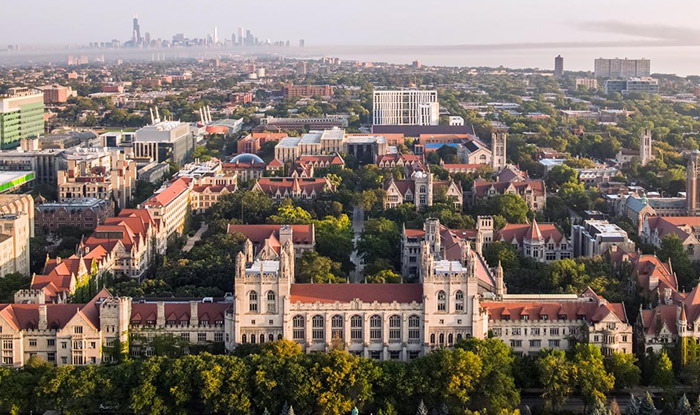
The campus is located in Hyde Park, in the southern part of Chicago. The Gothic-style buildings lining the campus create a calm and scholarly atmosphere reminiscent of medieval European universities. It is just a 20-minute train ride to downtown Chicago, allowing students to enjoy the convenience of the city.
The reason this school is considered prestigious is not simply due to grades or rankings. The University of Chicago teaches students "how to think." Rather than finding answers, it fosters the ability to ask questions and explore their meanings. Therefore, graduates grow into individuals who can find answers for themselves wherever they go.
Ultimately, the reputation of the University of Chicago lies not in its grand buildings or famous professors but in its 'intellectual challenge.' A serious passion for scholarship, a culture that values critical thinking, and the power of research that changes the world have made this school a true elite institution. Thus, the University of Chicago is still known as a place where the most 'desirable students' from around the world gather to study.
Notable Koreans who graduated from the University of Chicago include political scientist Choi Jang-jip, physicist Kim Young-ki, former politician Kim In-cheol, economist Kim Yong-hak, and Lee Won-joo, daughter of Samsung Chairman Lee Jae-yong. In addition to these, several academic figures such as Jeong Jin-seong, Lee Ji-soon, Ha Young-won, Lim Hyuk-baek, and Seo So-young are also alumni of the University of Chicago.




 Magic Cabbage School of Martial Arts |
 Vacation on Hawaii |
 morvex37 |
 Ari Songhan American Immigration Life |
 Bearded Strawberry Smoothie |
 Khan Film Blog Production |
 Illinois Mom |
 Rice Shop Uncle BLOG |
 Enjoyable American Life Diary |
 allstar realty |
  DREAM BIG |
  frostbite |
  330 Forever My Love |
  El Dorado |
  dralix58 |
  Gorama Round |
  Skydiving |
  dreamport |
  Yellow Snowman |
  Toaster Pizza Magic Show |
  velvetnom |
  Anytime Journey |
  Mrs. Duluth |
  jaxter |
  Atlanta Mama |
  Baguette Blog |
  Tan Sol |
  US Embassy |
  Korean Mom |
  My NYC |