

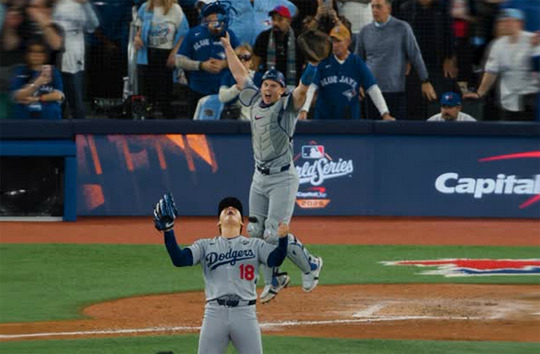
The LA Dodgers have done it again.
Following last year's victory, they lifted the World Series trophy again in 2025, becoming champions for the second consecutive year.
In Game 7 held at Rogers Centre in Ontario, Canada, they triumphed over the Toronto Blue Jays with a dramatic 5-4 win in the 11th inning, finishing the series with a record of 4 wins and 3 losses, becoming the heroes of a thrilling comeback drama. For Dodgers fans, who once waited 32 years for a championship, the word 'dynasty' now feels familiar.
This series was truly a series of remarkable matches. In particular, Game 3 was a fierce battle that went to 18 extra innings, keeping fans on the edge of their seats, and the final Game 7 was a nail-biting contest where the outcome was uncertain until the end. Until the bottom of the 9th, Toronto led 4-3 and seemed poised for victory, but the Dodgers tied the game with a dramatic hit in the top of the 10th, and a decisive hit in the top of the 11th completely turned the game around.
What stood out the most was the stellar performance of the three Japanese pitchers.
Shohei Ohtani, Roki Sasaki, and Yoshinobu Yamamoto. It is not an exaggeration to say that the Dodgers' mound was essentially dominated by Japanese players. Ohtani played a central role in the team, making the term two-way player seem inadequate. At the plate, he consistently delivered powerful hits, becoming the core of the offense, and on the mound, he subdued the opposing lineup at crucial moments. Roki Sasaki overwhelmed Toronto batters with his unique 160km fastball, and his scoreless relief appearance in Game 5 will be remembered as a moment that completely changed the team's momentum.
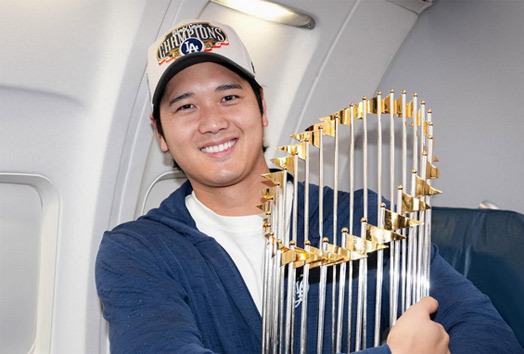
And all the spotlight ultimately turned to Yoshinobu Yamamoto.
He stabilized the team with consistent pitching throughout the series, calmly overcoming early crises in Game 7 and setting the stage for the Dodgers' comeback. His fastball, sharp control, and perfect game management skills are among the best in Major League Baseball. Ultimately, Yamamoto was named the MVP of this World Series, becoming a rare 'autumn hero' among Japanese pitchers.
The Dodgers' victory was an event that reaffirmed the status of Japanese baseball in Major League Baseball, beyond just the glory of the team. Japan has been consistently producing world-class players through a systematic pitcher development system. Ohtani's all-around performance, Sasaki's youthful energy, and Yamamoto's polished pitching proved that Japanese baseball does not succeed merely by 'luck.'
However, this naturally raises the question: Where are the Korean pitchers?
Once, Chan-ho Park and Hyun-jin Ryu proudly fought on the Dodgers' mound, but now that absence is too great.
While Japan has three pitchers leading a team on the world's biggest stage, Korea still faces the harsh reality of even entering Major League Baseball. The bigger issue than individual talent is the system. Japan has a systematic development program that spans high school, professional leagues, and national teams, while Korea still struggles to break free from outdated methods relying on 'fighting spirit' and 'grit.'
The Dodgers' back-to-back championships carry significance beyond just sports news. Japanese baseball has now firmly established itself as a mainstream presence in Major League Baseball, and Korean baseball must return to the starting line. As a baseball fan, I can only hope to see a Korean pitcher once again donning the Dodgers' blue uniform on the World Series mound and for the pride of Korean baseball to be revived once more.







 Weekend Movie Blog |
 Beauty, Health, Lifestyle Blog |
 coloradoman |
 Superman Cat Blog |
 Noodle Noodle |
  Tonky |
  viroma |
  cookie |
  Live and that's it |
  Alright Twain |
  eatontown blog |
  HAWAII Korean Church News |
  Amore |
  linex |
  Balancework |
  laro90 |
  MEDBIO American Doctor Blog |
  SWAT TEAM BLK |
  DREAM BIG |
  frostbite |
  330 Forever My Love |
  El Dorado |
  dralix58 |
  Gorama Round |
  Skydiving |